

Elbow (TL)#

Block appearance in REPEAT VISION#
The Elbow (TL) block simulates changes in energy and pressure of the fluid when passing the corresponding thermal-hydraulic system component.
When selecting the
Elbow typevalueSmoothly, the resistance coefficient is calculated as follows (1)
where:
f\(_T\) - dimensionless coefficient of friction, depending on the diameter of the elbow:
Elbow diameter, inch |
0.5 |
0.75 |
1 |
1.25 |
1.5 |
2 |
2.5-3 |
4 |
5 |
6 |
8-10 |
12-16 |
|---|---|---|---|---|---|---|---|---|---|---|---|---|
Coefficient f\(_T\) |
0.027 |
0.025 |
0.023 |
0.022 |
0.021 |
0.019 |
0.018 |
0.017 |
0.016 |
0.015 |
0.014 |
0.013 |
Note
f\(_T\) calculated in the same way as in p. 1 - according to the given table using interpolation for intermediate values
\(C_{angle}\) - correction factor for the bend angle of the elbow, which is calculated using the formula (2):
where \(\theta\) - is the bend angle of the elbow in [degrees].
When the
Elbow typeparameter is set toSharp Edgedthe resistance coefficient K is calculated as follows (1):
α |
0° |
15° |
30° |
45° |
60° |
75° |
90° |
|---|---|---|---|---|---|---|---|
K |
2f\(_T\) |
4f\(_T\) |
8f\(_T\) |
15f\(_T\) |
25f\(_T\) |
40f\(_T\) |
60f\(_T\) |
The mass flow rate through a pipe part is calculated as (3):
where:
А - cross-section area of the elbow, [m\(^2\)];
\(\bar\rho\) - liquid density, [kg/\(m^3\)];
\(\Delta p\) - pressure drop across the elbow, [Pa];
\(\Delta p_{crit}\) - critical pressure drop, [Pa].
The critical pressure drop \(\Delta p_{crit}\) is related to critical Reynolds number Re\(_{crit}\) at the boundary of the laminar and turbulent flow areas (4):
where:
\(\nu\) - kinematic viscosity of liquid, [m\(^2\)/s];
Re\(_{crit}\) - critical Reynolds number;
D - elbow diameter, [m] (fig. 1 below).
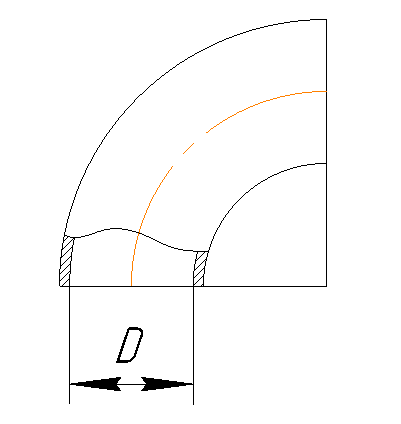
fig. 1 - Elbow 90°#
Law of conservation of mass (5):
Law of conservation of energy (6):
where:
\(\phi_А\) - energy flow at the input, [W];
\(\phi_B\) - energy flow at the output, [W].
1. Properties#
Property |
Default value |
Description |
Units of measurement |
|---|---|---|---|
Elbow type: |
Smoothly |
- |
- |
Hydraulic diameter |
0.5 |
- |
m |
Critical Reynolds number |
150.0 |
The Reynolds number at which the transition from laminar to turbulent flow occurs |
- |
Angle |
90.0 |
- |
deg |
2. Inputs and outputs#
Parameters |
Input/Output |
Description |
Units of measurement |
Port type |
|---|---|---|---|---|
Input |
Input |
- |
- |
Thermohydraulics |
Output |
Output |
- |
- |
Thermohydraulics |
In order to see the connection capabilities of the block, you need to go to page Description of block ports
See also
An examples of using this block can be found in the tutorials of the library Thermohydraulics: