

Ideal flow rate source (TPF)#
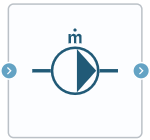
Block appearance in REPEAT VISION#
The Ideal flow rate source (TPF) block represents an ideal source of mechanical energy in a two-phase hydraulic network.
The source can maintain a given mass flow rate regardless of the pressure drop.
Important
The block has no flow resistance and no heat exchange with the environment.
A block can operate with or without performing work on the environment.
Law of Conservation of Mass (1) :
where:
\(\dot m_A\) – mass flow rate at the inlet, [kg/s];
\(\dot m_B\) – mass flow rate at the outlet, [kg/s].
Law of conservation of energy (2) :
where:
\(\phi_A\) - energy flow at the input, [W];
\(\phi_B\) - energy flow at the output, [W].
\(\phi_{раб}\) – power transmitted to the environment, [W].
If the mode without performing work is selected (3):
where \(h_A, h_B\) are the total enthalpies at the input and output, [J/kg].
where:
\(v\) – specific volume, [m\(^3\)/kg];
\(u\) – specific internal energy, [J/kg];
\(p\) – pressure, [Pa];
\(F\) – flow cross-sectional area, [m\(^2\)].
The work of an ideal flow source is isentropic (6) :
where \(s_A, s_B\) is the specific entropy of the medium at the input and output, [\(\frac{J}{kg \cdot K}\)].
Note
The user can select Source type - Controlled to change the flow rate during the simulation. In this case, the flow rate is determined by the signal sent to the corresponding port.
1. Properties#
Property |
Default Value |
Description |
Units of measurement |
|---|---|---|---|
Source type: |
Constant |
- |
- |
Mass flow rate |
1.0 |
- |
kg/s |
Power added: |
Isentropic |
- |
- |
Input port cross-sectional area |
0.01 |
- |
m\(^2\) |
Output port cross-sectional area |
0.01 |
- |
m\(^2\) |
2. Inputs and outputs#
Parameters |
Input/Output |
Description |
Units of measurement |
Port type |
|---|---|---|---|---|
Input |
Input |
- |
- |
Two-phase fluid |
Mass flow rate |
Input |
Available when |
kg/s |
Automation |
Output |
Output |
- |
- |
Two-phase fluid |
In order to see the connection capabilities of the block, you need to go to page Description of block ports