

Diode (SPICE model)#

Block appearance in REPEAT VISION#
The Diode (SPICE model) block is a SPICE model of a diode with a parallel resistance added to account for leakage effects. The block implements the following equivalent circuit:
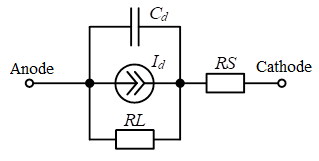
Substitution scheme#
The equivalent circuit contains the following elements:
\(C_d\) – p-n junction capacitance. Determined analytically depending on the block parameters and the voltage at the p-n junction;
\(I_d\) – current source that generates the p-n junction current. It is determined analytically depending on the block parameters and the voltage at the p-n junction;
\(R_L\) – active resistance simulating parasitic parallel resistance (leakage effect);
\(R_S\) – active resistance simulating parasitic series resistance.
A block can implement one of two conditions:
the presence of a nonlinear dependence on temperature;
absence of nonlinear dependence on temperature.
The general equation for the two temperature-dependent conditions is the equation (1):
where:
\(k\) is the Boltzmann constant, \(k=1.38 \cdot 10^{-23}\) [J/K];
\(T\) is the diode temperature, [K];
\(q\) is the elementary electric charge of an electron, \(q=1.602 \cdot 10^{-19}\) [C].
In the absence of a nonlinear dependence on temperature, the following equations are used (2), (3), (4), (5), (6), (7), (8), (9), (10), (11), (12) :
In the presence of a nonlinear dependence on temperature, the following equations are used (13), (14), (15), (16), (17), (18), (19), (20), (21), (22), (23), (24), (25), (26), (27), (28), (29), (30), (31), (32) :
1. Properties#
Property |
Default Value |
Description |
Units of measurement |
|---|---|---|---|
RL – leakage resistance |
100000.0 |
– |
Ohm |
T – diode temperature |
25.0 |
– |
℃ |
AREA - relative area of the diode |
1.0E7 |
– |
r.u. |
IKF - high-injection knee current |
0.0042 |
– |
А |
VJ - built-in potential |
1.0 |
– |
V |
M - grading coefficient |
0.5 |
– |
– |
IBV - reverse breakdown knee current |
1.0E-10 |
– |
А |
BV - reverse breakdown knee voltage |
1.0E7 |
– |
V |
NBV - reverse breakdown ideality |
1.0 |
– |
– |
IBVL - low-level reverse breakdown current |
0.0 |
– |
А |
NBVL - low-level reverse breakdown ideality |
1.0 |
– |
– |
IS - saturation current |
1.0E-15 |
– |
А |
ISR - recombination current parameter |
0.0 |
– |
V |
RS - parasitic series resistance |
0.0 |
– |
Ohm |
N - emission coefficient |
1.0 |
– |
– |
NR - emission coefficient for ISR |
2.0 |
– |
– |
CJO - zero-bias junction capacitance |
0.0 |
– |
F |
TT - transit time |
0.0 |
– |
s |
FC - forward-bias depletion coefficient |
0.5 |
– |
– |
Off |
– |
– |
|
TMEAS - diode temperature when measuring parameters |
25.0 |
– |
℃ |
XTI - temperature exponent for IS, available when selecting |
3.0 |
– |
– |
EG - energy gap, available when selecting |
1.11 |
– |
eV |
TIKF - IKF temperature coefficient (linear), available when selecting |
0.0 |
– |
– |
TBV1 - BV temperature coefficient (linear), available when selecting |
0.0 |
– |
– |
TBV2 - BV temperature coefficient (quadratic), available when selecting |
0.0 |
– |
– |
TRS1 - RS temperature coefficient (linear), available when selecting |
0.0 |
– |
– |
TRS2 - RS temperature coefficient (quadratic), available when selecting |
0.0 |
– |
– |
2. Inputs and outputs#
Parameters |
Input/Output |
Description |
Units of measurement |
Port type |
|---|---|---|---|---|
Anode |
Input |
- |
- |
Electronics |
Kathode |
Output |
- |
- |
Electronics |
In order to see the connection capabilities of the block, you need to go to page Description of block ports