

Locomotive (with wheel slip)#
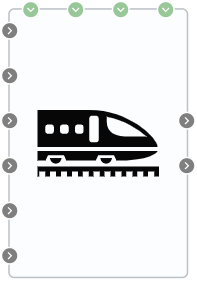
Block appearance in REPEAT VISION#
The Locomotive (with wheel slip) block describes themovement of a locomotive with carriages attached to it, taking intoaccount the road profile and wind.
Forces acting on the train:
rolling force (1) :
where:
\(m_l\) - locomotive weight, [kg];
\(g\) – gravity factor;
\(sin\alpha\) – elevation angle.
rolling friction force (2) :
where:
\(K_{тр}\) – rolling friction coefficient, [m];
\(sin\alpha\) – elevation angle, [rad];
\( r \) – radius of the locomotive wheel, [m].
adhesion force (3) :
where \(V_п\) - train speed, [m].
maximum adhesion force (4) :
aerodynamic drag force (5) :
where:
\( \)k_{аэро}$ – locomotive drag coefficient, [kg/m];
\(k_{вязк}\) – locomotive viscous drag coefficient, [kg/s];
\(V_{сумм}=V_п + V_в\) – sum of train and headwind velocities, [m/s].
Equation of moments (6) :
where:
\( M_{\mathrm{т}\mathrm{я}\mathrm{г}}=M_{\mathrm{д}\mathrm{в}}+M_{\mathrm{д}\mathrm{о}\mathrm{п}.\mathrm{д}\mathrm{в}.1}+M_{\mathrm{д}\mathrm{о}\mathrm{п}.\mathrm{д}\mathrm{в}.2}+M_{\mathrm{д}\mathrm{о}\mathrm{п}.\mathrm{д}\mathrm{в}.3} \) – tractive torque of a locomotive with additional motors connected in parallel, [N\(\cdot\) m]
\( M_{\mathrm{т}\mathrm{о}\mathrm{р}\mathrm{м}}=M_{\mathrm{т}\mathrm{о}\mathrm{р}\mathrm{м}}\mathrm{\cdot}\mathrm{s}\mathrm{i}\mathrm{n}(n) \) – brake torque, [N\(\cdot\) m];
\(I_{\mathrm{о}\mathrm{с}}\) – moment of inertia of wheelsets, [kg/m\(^2\)];
\(w\) – angular velocity of the locomotive wheel, [rad/s];
\(dw\) – change in angular velocity of the locomotive wheel over time.
Condition of wheels slipping during acceleration (wheelspin) (7) :
where:
\( F_{\mathrm{с}\mathrm{ц}\mathrm{е}\mathrm{п}.\mathrm{м}\mathrm{а}\mathrm{к}\mathrm{с}}\) – maximum adhesive force, [N];
\(r\) – locomotive wheel radius, [m].
Condition of wheels slipping when braking (slip) (8) :
where:
\(F_{\mathrm{с}\mathrm{ц}\mathrm{е}\mathrm{п}.\mathrm{м}\mathrm{а}\mathrm{к}\mathrm{с}}\) – maximum adhesive force, [N];
\(r\) – locomotive wheel radius, [m].
Movement with slippage (9) :
where \( F_{\mathrm{п}\mathrm{р}\mathrm{и}\mathrm{ц}}\) – drag force of the coupled carriages, [N].
Movement with slip (10),(11) :
1. Properties#
Property |
Default value |
Description |
Units of measurement |
|---|---|---|---|
Radius of wheel |
0.625 |
– |
m |
Inertia moment of all axes |
3200 |
– |
kg\(\cdot\) m\(^2\) |
Locomotive mass |
180000 |
– |
kg |
Rail friction coefficient |
0.12 |
– |
r.u. |
Locomotive head resistance coefficient |
23.0 |
– |
kg/m |
Locomotive viscosity resistance coefficient |
32.6 |
– |
kg/s |
Rolling friction coefficient |
0.0005 |
– |
m |
Free fall acceleration |
9.81 |
– |
m/s\(^2\) |
2. Inputs and outputs#
Parameters |
Input/Output |
Description |
Units of measurement |
Port type |
|---|---|---|---|---|
Motor torque |
Input |
– |
N \(\cdot\) m |
Rotational motion |
Braking torque |
Input |
– |
N \(\cdot\) m |
Automation |
Climb angle |
Input |
– |
rad |
Automation |
Headwind speed |
Input |
– |
m/s |
Automation |
Carriage motion resistance force |
Input |
– |
N |
Automation |
Railway carriages mass |
Input |
– |
kg |
Automation |
Additional motor torque 1 |
Input |
Port for connecting an additional motor. The calculation assumes that the load is distributed symmetrically on all axes. |
N \(\cdot\) m |
Rotational motion |
Additional motor torque 2 |
Input |
Port for connecting an additional motor. The calculation assumes that the load is distributed symmetrically on all axes. |
N \(\cdot\) m |
Rotational motion |
Additional motor torque 3 |
Input |
Port for connecting an additional motor. The calculation assumes that the load is distributed symmetrically on all axes. |
N \(\cdot\) m |
Rotational motion |
Gear ratio |
Input |
– |
r.u. |
Automation |
Angular velocity of the driving wheels |
Output |
– |
rad/s |
Automation |
Train speed |
Output |
– |
m/s |
Automation |
In order to see the connection capabilities of the block, you need to go to page Description of block ports