

Relay#
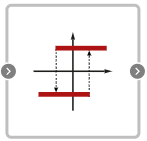
Block appearance in REPEAT VISION#
The Relay block is a model of a simple classic relay with two stable states. The model operates according to the following algorithm:
if the input signal is greater than or equal to the specified activation signal (in \(\geq\) x\(_{on}\)), then the relay switches to the enabled position and generates the respective signal value at the output (out = y\(_{on}\));
if the input signal is greater than or equal to the specified tripping signal (in \(\leq\) x\(_{off}\)), then the relay switches to the enabled position and generates the respective signal value at the output (out = y\(_{off}\));
if the input signal is less than the specified activation signal (in < x\(_{on}\)) and more than the specified tripping signal (in > x\(_{off}\)), then a signal equal to the previous relay state is generated at the relay output.
The operation of the block can be described by the following equation (1):
where:
\(x_{on}\) – value of input signal at which the relay “turns on”;
\(x_{off}\) – value of input signal at which the relay “turns off”;
\(y_{on}\) – value of output signal at which the relay is “on”;
\(y_{off}\) – value of output signal at which the relay is “off”.
The operation of the block is graphically shown on the static characteristic given in Fig. 1:
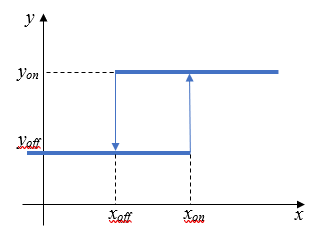
Fig. 1 Static characteristic of relay#
1. Properties#
Property |
Default Value |
Description |
Units of measurement |
|---|---|---|---|
Value of input signal to activate |
1.0 |
- |
- |
Value of input signal to trip |
0.0 |
- |
- |
Value of output signal at enabled state |
1.0 |
- |
- |
Value of output signal at disabled state |
0.0 |
- |
- |
2. Inputs and outputs#
Parameters |
Input/Output |
Description |
Units of measurement |
Port type |
|---|---|---|---|---|
Input signal |
Input |
Signal |
- |
Automation |
Output signal |
Output |
Signal |
- |
Automation |
In order to see the connection capabilities of the block, you need to go to page Description of block ports