

Trailer with braking system#
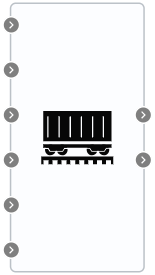
Block appearance in REPEAT VISION#
The Trailer with braking system block describes the movement ofcarriages attached to the locomotive taking into account slippage, track profile and wind.
Forces acting on each carriage:
rolling force (1):
where:
\(m_c\) – carriage mass, [kg];
\(g\) – gravity factor, [m/s\(^2\)];
\(sin\alpha\) – elevation angle, [rad].
rolling friction force (2) :
where:
\(K_{fr}\) – rolling friction coefficient, [m];
\(\alpha\) – elevation angle, [rad];
\(r\) – carriage wheel radius, [m].
adhesion force (3) :
where \(V_t\) - train speed, [m].
maximum adhesion force (4) :
aerodynamic drag force (5) :
where:
\(k_{drag}\) – carriage drag coefficient, [kg/m];
\(k_{visc}\) – carriage viscous drag coefficient, [kg/m];
\(V_{sum}=V_t + V_h\) – sum of train and headwind velocities, [m/s].
Condition of wheels slipping when braking (slip) (6) :
where:
\(M_{max}\) – maximum wheel torque, [N \(\cdo\)t m], (7) :
\(M_{brak}\) – brake torque, [N\(\cdot\) m].
Calculation (8) :
where:
\(K_{w}\) – number of wagons in the coupling;
\(m_{c}\) – carriage mass, [kg];
\(m_{coup}\) – coupling mass, [kg].
1. Properties#
Property |
Default value |
Description |
Units of measurement |
|---|---|---|---|
Number of wagons in the coupling, gearless |
90 |
– |
gearless |
Radius of wheel |
0.625 |
– |
m |
Mass of one wagon |
68000 |
– |
kg |
Rail friction coefficient |
0.12 |
– |
gearless |
Wagon head resistance coefficient |
0.0 |
– |
kg/m |
Wagon viscosity resistance coefficient |
32.6 |
– |
kg/s |
Rolling friction coefficient |
0.0005 |
– |
m |
Free fall acceleration |
9.81 |
– |
m/s\(^2\) |
2. Inputs and outputs#
Parameters |
Input/Output |
Description |
Units of measurement |
Port type |
|---|---|---|---|---|
Train speed |
Input |
– |
m/s |
Automatics |
Brake torque |
Input |
– |
N\(\cdot\) m |
Automatics |
Climb angle |
Input |
– |
rad |
Automatics |
Headwind speed |
Input |
– |
m/s |
Automatics |
Train carriage motion resistance force |
Input |
– |
N\(\cdot\) m |
Automatics |
Train carriage mass |
Input |
– |
kg |
Automatics |
Train carriage motion resistance force |
Output |
– |
N\(\cdot\) m |
Automatics |
Train carriage mass |
Output |
– |
kg |
Automatics |
In order to see the connection capabilities of the block, you need to go to page Description of block ports