

Convective heat transfer with calculation of heat transfer coefficient#
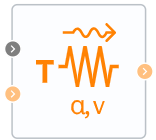
Block appearance in REPEAT VISION#
The Convective heat transfer with calculation of heat transfer coefficient block describes the heat transfer between air flows and the body surface.
Heat flux in the block according to the Newton’s law of cooling (1) :
where:
\(k\) - heat transfer coefficient, [W/(m\(^2\) \(\cdot\) ℃)];
\(F\) - surface area of the heat exchange, [m\(^2\)];
\(T_1\) - air temperature, [℃];
\(T_2\) - temperature of the body surface, [℃].
Calculation of the heat transfer factor
Calculation of heat transfer factor Convective heat transfer is described by the criterion equation as follows (2) :
where:
\(\mathrm{N}\mathrm{u}=\frac{k\cdot l}{\lambda }\) - Nusselt criterion;
\(\mathrm{R}\mathrm{e}=\frac{w\cdot l}{\nu }\) - Reynolds criterion;
\( \mathrm{P}\mathrm{r}=\frac{\nu }{\mathrm{а}}\) - Prandtl criterion;
\( \mathrm{G}\mathrm{r}=\frac{g\cdot l^{3}}{\nu ^{2}}\beta ∆\mathrm{t}\) - Grashof criterion;
\( Г=\frac{l_{i}}{l}\) - dimensionless geometric simplex;
\(k\) = heat transfer factor, [\(\frac{\mathrm{В}}{\mathrm{m}^{2}\cdot \mathrm{℃}}\)];
\(\nu\) - kinematic viscosity coefficient of the heat transfer medium, [\(\frac{m^2}{s}\)];
\(\omega\) - heat transfer medium speed, [\(\frac{m}{s}\)];
\(a\) - thermal diffusivity coefficient, [\(\frac{m^2}{s}\)];
\(g\) - gravity factor, [\(\frac{m^2}{s}\)];
\(l\) - defining dimension, [m];
\(l_i\) - characteristic dimension, [m];
\( \beta \) - thermal expansion coefficient, [\(\frac{1}{K}\)];
\(\Delta t = t_{wall} - t_{f}\) - temperature difference between the wall and the heat transfer medium, [℃];
\(\lambda\) - heat transfer coefficient of the heat transfer medium, [\(\frac{\mathrm{W}}{\mathrm{m}\cdot \mathrm{℃}}\)];
The heat transfer coefficient is calculated using the following formula (3) :
The Nusselt criterion for forced flow in straight pipes and channels is calculated using the following equations:
Laminar flow of the heat transfer medium, \( \mathrm{R}\mathrm{e}\le 2320\) (4) :
where:
\( \Pr_{ст}\) - Prandtl criterion for the heat transfer medium with the wall temperature;
\(\epsilon_l\) - – coefficient determined from the tables 1 and 2;
Transient flow of the heat transfer medium, \( 2320\le \mathrm{R}\mathrm{e}<10000\) (5) :
Turbulent flow of the heat transfer medium, \(\mathrm{R}\mathrm{e}\ge 10000\) (6) :
The defining temperature in the equations presented above is the mean temperature of the fluid, the defining dimension is the equivalent diameter of the flow cross-section (7) :
where:
\(S\) - cross-sectional area of liquid flow, [m\(^2\)];
П - wetted perimeter, [m].
Table 1 - \(\epsilon _1\) coefficient value if \(Re < 10000\)
\(\frac{l}{d_{equ}}\) |
1 |
2 |
5 |
10 |
15 |
20 |
30 |
40 |
50 |
|---|---|---|---|---|---|---|---|---|---|
\( \epsilon_l \) |
1,9 |
1,7 |
1,44 |
1,26 |
1,18 |
1,13 |
1,05 |
1,02 |
1 |
Table 2 - \(\epsilon _1\) coefficient value if \(Re > 10000\)
Re |
\(\frac{l}{d_{equ}}\) |
||||
|---|---|---|---|---|---|
10 |
20 |
30 |
40 |
50 |
|
\(1 \cdot 10^4\) |
1.23 |
1.13 |
1.07 |
1.03 |
1 |
\(2 \cdot 10^4\) |
1.18 |
1.1 |
1.05 |
1.02 |
1 |
\(5 \cdot 10^4\) |
1.13 |
1.08 |
1.04 |
1.02 |
1 |
\(1 \cdot 10^5\) |
1.1 |
1.06 |
1.03 |
1.02 |
1 |
\(1 \cdot 10^6\) |
1.05 |
1.03 |
1.02 |
1.01 |
1 |
For free convection, the Nusselt criterion is calculated using the following formula (8):
where C and n depend on the mode of heat transfer medium flow and are determined according to the Table 3.
Table 3 - Value of coefficient C and the exponent n
Mode |
\(Gr \cdot Pr\) |
\(C\) |
\(n\) |
|---|---|---|---|
Laminar |
\( 1\cdot 10^{-3}\div 5\cdot 10^{2}\) |
1,18 |
0,125 |
Transient |
\( 5\cdot 10^{2}\div 2\cdot 10^{7}\) |
0,54 |
0,25 |
Turbulent |
\( 2\cdot 10^{7}\div 1\cdot 10^{12}\) |
0,185 |
0,33 |
The defining geometric dimension is the height of the vertical heat exchange surface, in case of horizontal pipes it is the diameter. The defining temperature is the average temperature of the heat transfer medium.
For plate flow the Nusselt criterion is calculated by formulas:
laminar flow of coolant \(Re < 5 \cdot 10^5\) (9):
turbulent mode of coolant flow (10):
Calculation of the Nusselt criterion for natural and forced convection of a horizontal cylinder
The determining temperature: t=\(\frac{(t_{ст}+t_ж)}{2}\), the determining size is the diameter.
Natural convection: (11):
Forced convection: (12):
Table 4 - The value of the coefficient C and the exponent m
Re |
\(C\) |
\(m\) |
|---|---|---|
< 4 |
0,989 |
0,33 |
4 - 40 |
0,911 |
0,385 |
4 - 4000 |
0,683 |
0,466 |
4000 - 40000 |
0,193 |
0,618 |
> 40000 |
0,027 |
0,805 |
Calculation of the Nusselt criterion for natural and forced convection of a plate
Determining temperature: t=\(\frac{(t_{ст}+t_ж)}{2}\), determining size:
Table 5 - Value of coefficient C and degree index m
Plate inclination angle |
Defining size |
|---|---|
0 or 180 |
\(\frac{(L\cdot W)}{2\cdot (L+W)}\) |
0 < Plate angle < 180 |
L |
where:
L - plate length, [m];
W - plate width, [m].
Natural convection
Cold plate - hot coolant
Tilt angle = 0 (13):
0 < Inclination angle < 30 (14):
where \(\alpha\) is the plate inclination angle, [deg].
30 ≤ Inclination angle < 90 (15):
where \(\alpha\) is the plate inclination angle, [deg].
Inclination angle = 90 (16):
90 < Inclination angle < 180 (17):
where \(\alpha\) is the plate inclination angle, [deg].
Inclination angle = 180
Ra < 4.74E6 (18):
Ra > 4.74E6 (19):
Hot plate - cold coolant
Inclination angle = 0
Ra < 4.74E6 (20):
Ra > 4.74E6 (21):
0 < Inclination angle < 90 (22):
where \(\alpha\) is the plate inclination angle, [deg].
Inclination angle = 90 (23):
90 ≤ Inclination angle < 150 (24):
where \(\alpha\) is the plate inclination angle, [deg].
150 < Inclination angle < 180 (25):
where \(\alpha\) is the plate inclination angle, [deg].
Inclination angle = 180 (26):
Forced convection
Laminar flow Re < 31836 (27):
Turbulent flow Re > 31836 (28):
1. Properties#
Property |
Default value |
Description |
Units of measurement |
|---|---|---|---|
Surface area |
10 |
- |
m\(^2\) |
Convection type: |
Natural convection |
- |
- |
Flow around type: |
Straight pipes |
- |
- |
Characteristic dimension |
10 |
- |
m |
Pipe length |
10 |
Available, when |
m |
Wetted perimeter |
30 |
Available, when |
m |
Cross-sectional area of medium flow |
30 |
Available, when |
m\(^2\) |
Plate inclination angle |
60 |
Available, when |
ᵒ |
Plate width |
20 |
Available, when |
m |
Plate length |
20 |
Available, when |
m |
2. Inputs and outputs#
Parameters |
Input/Output |
Description |
Units of measurement |
Port type |
|---|---|---|---|---|
Velocity |
Input |
- |
m/s |
Automation |
Input |
Input |
- |
- |
Heat exchange |
Output |
Output |
- |
- |
Heat exchange |
In order to see the connection capabilities of the block, you need to go to page Description of block ports