

Confusor / Area Change (IH)#
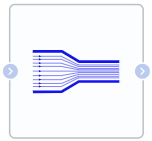
Block appearance in REPEAT VISION#
The Confusor / Area Change (IH) unit describes the appropriate types of local resistance in the isothermal liquid piping.
For a Confuser, as fluid moves from the inlet to the outlet, the cross-sectional area of the flow narrows and the velocity of the fluid increases; when moving back, it expands; for a Diffuser, it’s vice versa.
Hint
The cross-sectional area can be specified by conditions - in this case the block will operate as a local resistance of constant diameter.
The loss coefficients for a block can be set empirically or using a tabular method.
If calculated based on empirical data:
For gradual conical compression in the range 0 to 45 degrees, the coefficient of friction is calculated as (1):
where R - the ratio of the area of the smaller port to the area of the larger port.
For compression from 45 to 180 degrees (not inclusive) (2):
For 180-degree compression (3):
For gradual conical expansion in the range 0 to 45 degrees, the coefficient of friction is calculated as (4):
For extend from 45 to 180 degrees (inclusive) (5):
In the case of calculations using tabular data, the vectors of loss coefficients during compression and expansion are assigned to the vector of Reynolds numbers. All three vectors are specified by the user as model parameters.
The total hydraulic loss factor for the diffuser pipe section is calculated as (6):
where:
\(\dot m_{A}\) - mass flow rate on the entry port, [kg/s];
\(\dot m_{th}\) - threshold mass flow, [kg/s], at which a change in the direction of movement of the liquid occurs, associated with a critical Reynolds (7):number:
where:
\(A_{R}\)- area of the smallest of two sections, [m\(^2\)];
\(ν\) - liquid kinematic viscosity, [m/s\(^2\)];
\(\bar ρ\) - liquid density, [kg/m\(^3\)];
\(D_{h}\) - is the diameter corresponding to the smallest cross-sectional area AR, which is calculated as (8):
The pressure differential across the diffuser pipe section is calculated as follows (9):
where (10):
1. Properties#
Property |
Default value |
Description |
Units of measurement |
|---|---|---|---|
Coefficient calc method: |
Empirical |
- |
- |
Contraction loss coefficient, available when |
1.0 |
- |
- |
Expansion loss coefficient, available when |
1.0 |
- |
- |
Critical Reynolds number, available when |
150.0 |
The Reynolds number at which the transition from laminar to turbulent flow occurs |
- |
Angle, available when |
30.0 |
- |
degrees |
Bigger area (port A) |
0.02 |
- |
m\(^2\) |
Smaller area (port B) |
0.01 |
- |
m\(^2\) |
Reynolds number Vector, available when |
{10,20,30,40,50,100,200,500,1000,2000} |
- |
- |
Contraction loss coefficient vector, available when |
{5,2.7,1.8,1.46,1.3,.9,.65,.42,.3,.2} |
- |
- |
Expansion loss coefficient vector, available when |
{3.1,2.3,1.65,1.35,1.15,.9,.75,.65,.55,.45} |
- |
- |
2. Inputs and outputs#
Parameters |
Input/Output |
Description |
Units of measurement |
Port type |
|---|---|---|---|---|
Input |
Input |
- |
- |
Isothermal hydraulics |
Output |
Output |
- |
- |
Isothermal hydraulics |
In order to see the connection capabilities of the block, you need to go to page Description of block ports