

Disc brake#
Block appearance in REPEAT VISION#
A Disc brake unit is a braking device consisting of a cylinder that applies pressure to one or more pads that contact the disc. When pressure from the cylinder occurs, the pads create a braking torque.
Fig. 1 shows the design of a disc brake:
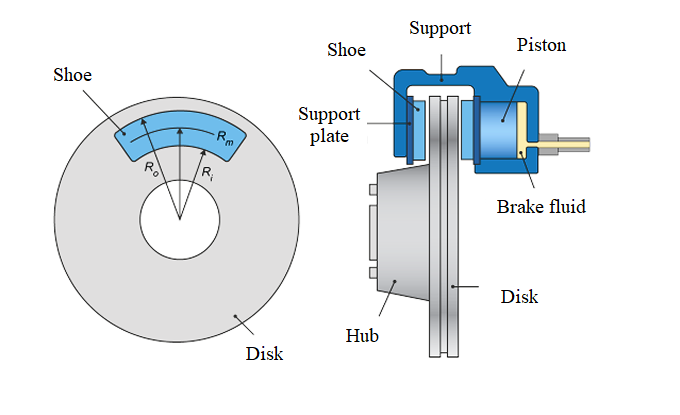
Fig. 1 Disc brake design#
A disc brake converts the pressure in the brake cylinder into a force applied along the average radius of the brake pad. The equation the unit uses to calculate the braking torque depends on the angular velocity of the wheel, \(\omega\):
When \(\omega\ne0\) (1) :
At \(\omega = 0\), the braking torque is maximum and equal to the external torque applied to the disk. At zero angular velocity, the maximum value of the braking torque is defined as (2) :
where:
\(T\) - braking torque, [N·m];
\(P\) - piston pressure, [Pa];
Important
The input pressure is set in bars.
\(\omega\) - angular velocity of the disk, [rad/s];
\(N\) - number of brake pads;
\(\mu_k\) - coefficient of sliding friction;
\(\mu_s\) - coefficient of static friction;
\(D_b\) - brake piston diameter, [m];
\(R_o\) - outer radius of the brake pad, [m];
\(R_i\) - inner radius of the brake pad, [m];
\(R_m=\frac{R_o+R_i}{2}\) - average radius of application of the pad force to the disc, [m].
In addition to the dry braking torque, viscous friction can be taken into account by setting the Viscous friction coefficient parameter value greater than zero, then the braking torque is calculated using the expression (3):
where \(k_{visc}\) is the coefficient of viscous friction, [N·m/(rad/s)].
1. Properties#
Property |
Default Value |
Description |
Units of measurement |
|---|---|---|---|
Mean pad radius |
0.15 |
- |
m |
Cylinder bore diameter |
0.01 |
- |
m |
Number of brake pads |
2 |
- |
- |
Static friction coefficient |
0.9 |
- |
- |
Coulomb friction coefficient |
0.7 |
- |
- |
0.0 |
- |
- |
|
Breakaway friction velocity |
0.1 |
- |
rad/s |
2. Inputs and outputs#
Parameters |
Input/Output |
Description |
Units of measurement |
Port type |
|---|---|---|---|---|
Pressure |
Input |
- |
bar |
Automation |
Shaft |
Output |
- |
- |
Rotational motion |
In order to see the connection capabilities of the block, you need to go to page Description of block ports