

Approximation model (Heat exchange)#

Appearance of the approximation model launching block#
Approximation model (Heat exchange) block is intended for use within the library Heat exchange of the set approximation models:
Neural networks, which are part of the algorithms of machine learning;
Gaussian processes;
Linear and nonlinear regression models.
Approximation Models can contain any nonlinear relations between the input parameters of the Model and calculation results that are difficult to describe by a software algorithm and require modern approaches such as neural networks and other machine learning methods.
The block is designed to call ((Inference)) approximation model and enable communication with other blocks of library Heat exchange.
Approximation model (Heat exchange) block loads the model from the neutral format ONNX.
See also
Please see the how-to for an implementation of a simple heat conduction machine learning model and steps for integrating the model into the REPEAT VISION platform.
Note
The External models library contains the Approximation model block, which is used to call ML models during modeling and exchange data with the Automation library blocks and other blocks containing the port type Automation.
1. Requirements for an approximation model interacting with Heat exchange library blocks#
Important
The basic requirements for the approximation model are presented in the description of a similar block of the library External models.
1.1. Requirements for formulating an approximation problem#
The approximation model must describe the physical process of heat exchange or heat transfer in the modeled system, expressing the dependence of heat fluxes \(\mathbf H_i\) on temperatures \(\mathbf T_{i}\) (1).
A constituent element of the approximation model must be a model node. Each node \(i\) of the approximation model includes the temperature parameter \(\mathbf T_{i}\) and the result of the heat flux calculation \(\mathbf H_i\).
in dependence (1) index \(i\) denotes the serial number of the model node.
The approximation model must contain at least one node with the temperature parameter T₁ and the calculated value of the heat flow H₁.
Sign convention for calculating heat fluxes#
Positive direction of heat flow is accepted in the node of the approximation model.
The direction of heat flow from a model node is considered to be negative.
The diagram below shows two nodes of the approximation model with positive direction of the calculated heat flux values.
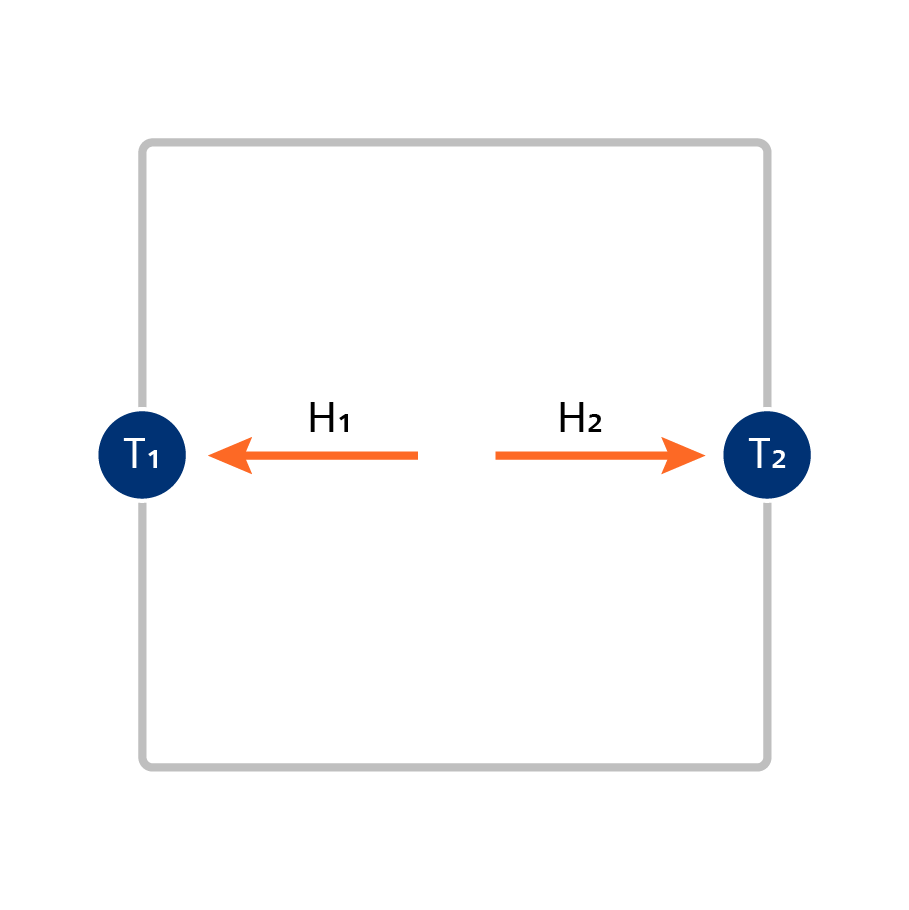
Sign rule for calculating heat fluxes for an approximation model with two nodes.#
The diagram above uses the following notations.
Designations |
Description |
|---|---|
Blue circles |
Model nodes with temperature parameters \(\mathbf T_i\) |
Orange vectors |
Positive directions of heat flows of the \(\mathbf H_i\) model |
Option for calculating heat flow from one node to another#
The approximation model can contain two nodes, calculating one value of the heat flux \(\mathbf H\) directed from node 1 to node 2 according to the scheme given below.
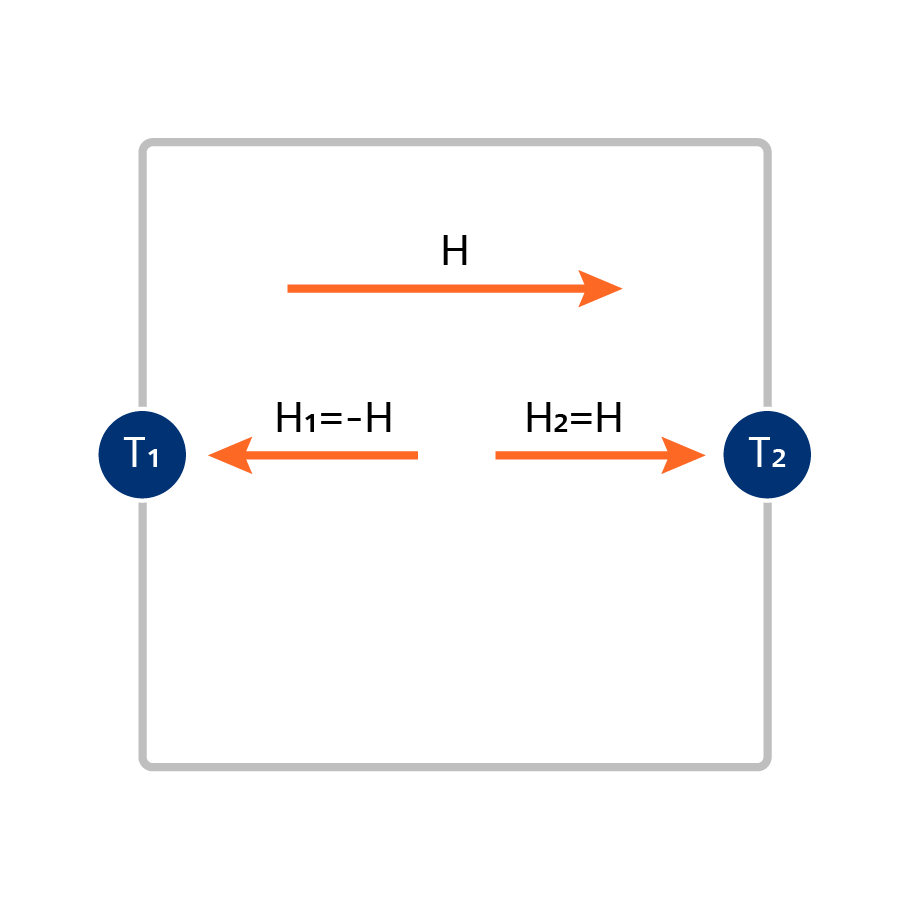
Calculation of heat flow from node 1 to node 2 of an approximation model with two nodes.#
In the case given above, the heat flux directed to node 2 is \(\mathbf H\), and the heat flux of node 1 is \( - \mathbf H\).
Option for calculating heat flow in three nodes#
The approximation model can contain three or more nodes, calculating the values of heat flows \(\mathbf H_i = f(\mathbf T_{i})\), in each of the model nodes.
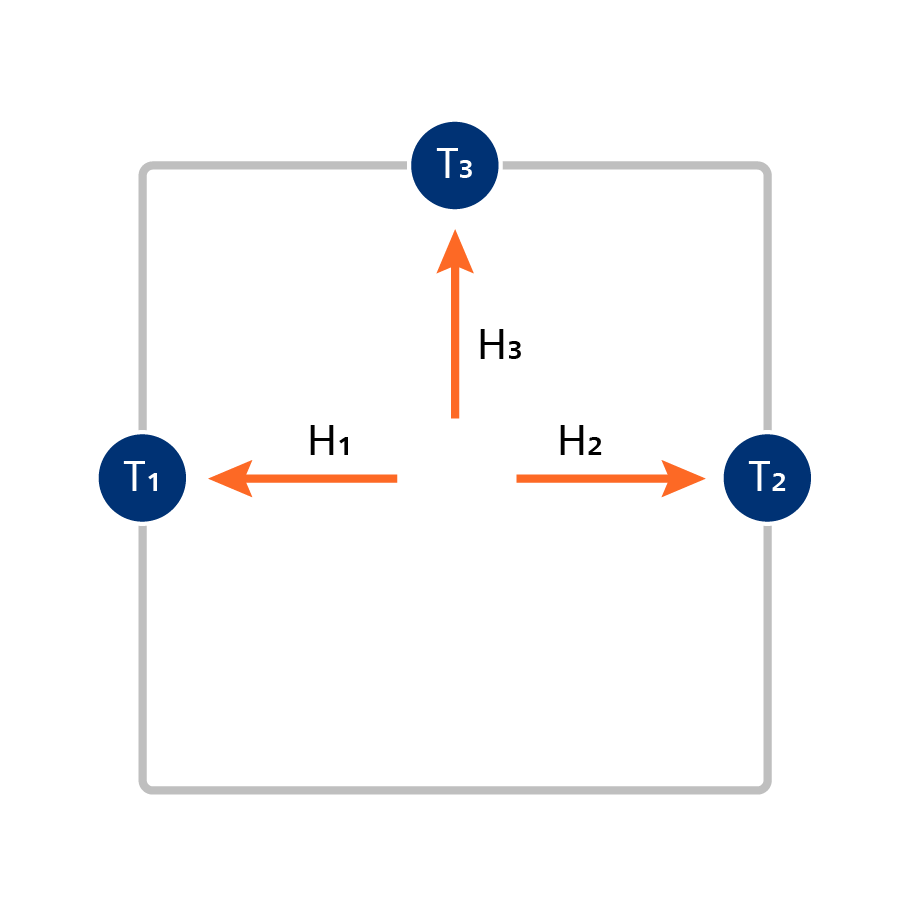
Calculation of heat flow in three nodes of the approximation model.#
1.2. Requirements for the parameters of the approximation model#
An approximation model that interacts with the blocks of the Heat exchange library must:
The input parameters are the temperature values (T₁,T₂,Tₙ in the figure below) of the modeled element of the product or system;
As a result of the calculation, the model should provide heat flow values (H₁, H₂, Hₙ in the figure below).
Исходные данные и результаты расчёта Аппроксимационной модели (Теплообмен)#
The following notations are used in the figure above.
Designation |
Dimension |
Description |
|---|---|---|
T₁, … , Tₙ |
\(^{\circ}C\) |
Initial temperature values of the approximation model |
H₁, … , Hₙ |
W |
Heat flow calculation results |
The physical quantities of the initial data and the results of the approximation model calculations must be presented in the SI system of units.
2. Properties#
No
3. Inputs and outputs#
Parameters |
Input/Output |
Description |
Units of measurement |
Port type |
|---|---|---|---|---|
Temperatures |
Input |
The list of input ports is generated based on the information about the set of input parameters of the model from the ONNX file |
\(^{\circ}C\) |
Heat exchange |
Heat flows |
Output |
The list of output ports is generated based on information about the set of output parameters (calculation results) of the model from the ONNX file |
W |
Automation |
The block output ports are required to obtain the results of heat flow calculations for the model, as well as to transfer the calculation results to the Outport block.
Important
The Meter block does not support displaying the calculation results of the Approximation model (Heat exchange) block.
In order to see the connection capabilities of the block, you need to go to page Description of block ports
4. Examples of use#
Examples of using this block can be found in the following sections:
Tutorials;
Description of Demo.
How-to guides
Section |
Guide name |
|---|---|
Machine learning approximation |