

Saturated fluid chamber (TPF)#
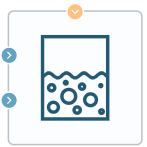
Block appearance in REPEAT VISION#
The Saturated fluid chamber (TPF) is a chamber with a constant volume. The chamber volume is divided into the volume of liquid at saturation and the volume of vapor at saturation.
Input port 1 is connected to a volume of vapor, and input port 2 to a volume of liquid. Thus, the medium leaving input port 1 is always saturated vapor, and from port 2, it is saturated liquid. The input medium can be in any state.
Law of Conservation of Mass (1) :
where:
\(M\) – mass of the medium in the chamber, [kg];
\(\dot m_A\) – mass flow rate at input 1, [kg/s];
\(\dot m_B\) – mass flow rate at output 2, [kg/s].
Law of conservation of energy (2) :
where:
\(\phi_A\) - energy flow at the input 1, [W];
\(\phi_B\) - energy flow at the output 2, [W].
\(Q\) – heat flow through the heat port, [W];
\(u_K\) – specific internal energy of the environment in the chamber, [J/kg].
Impulse balance
It is assumed that the pressure drop between the input ports and the internal volume of the chamber is negligible, so (3) :
\(p_1\) – pressure at input 1, [Pa];
\(p_2\) – pressure at input 2, [Pa];
\(p_K\) – pressure in the chamber, [Pa].
Mass of medium in chamber (4) :
where:
\(M_п\) – mass of saturated steam in the chamber, [kg];(5)
\(M_ж\) is the mass of saturated liquid in the chamber, [kg].(6)
where:
\(L\) – volume fraction of liquid in the chamber;
\(V\) – chamber volume, m\(^3\);
\(v_п\) – specific volume of saturated steam, [m\(^3\)/kg].
where \(v_ж\) is the specific volume of saturated liquid, [m\(^3\)/kg].
Heat port temperature
It is assumed that the thermal resistance between the thermal port and the internal volume of the chamber is negligible, thus (7) :
where:
\(T_П\) – temperature in the heating port, [\(^о\)C];
\(T_K\) - temperature of the environment in the chamber, [\(^о\)C];
Note
The block contains the properties: Minimum liquid volume fraction and Maximum liquid volume fraction. These properties regulate the minimum and maximum permissible level of the liquid fraction; if the maximum is exceeded or the minimum level falls below, the calculation will end with a corresponding error in the log:
The minimum volume fraction of the liquid phase cannot be less than 0;The maximum volume fraction of the liquid phase cannot be greater than 1.
1. Properties#
Property |
Default Value |
Description |
Units of measurement |
|---|---|---|---|
Chamber volume |
1.0 |
- |
m\(^3\) |
Port 1 cross-sectional area |
0.01 |
- |
m\(^2\) |
Port 2 cross-sectional area |
0.01 |
- |
m\(^2\) |
Initial gauge saturation chamber pressure |
0 |
- |
Pa |
Initial liquid volume fraction |
0.5 |
- |
- |
0.01 |
- |
- |
|
0.99 |
- |
- |
2. Inputs and outputs#
Parameters |
Input/Output |
Description |
Units of measurement |
Port type |
|---|---|---|---|---|
Input 1 |
Input |
- |
- |
Two-phase fluid |
Input 2 |
Input |
- |
- |
Two-phase fluid |
Heat port |
Input |
- |
- |
Heat exchange |
In order to see the connection capabilities of the block, you need to go to page Description of block ports