

Two chamber pneumatic cylinder (P)#
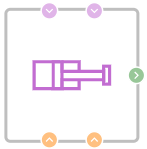
Block appearance in REPEAT VISION#
The Two chamber pneumatic cylinder (P) block models a pneumatic cylinder controlled by two gas chambers. The force generated depends on the pressure difference between the media in the chambers.
1. Mass conservation equations for the chamber (1) :
where:
\( ho\) - gas density, [kg/m\(^3\)];
ϑ - piston speed, [m/s];
S - piston area, [m\(^2\)];
\(\beta\) - gas elastic modulus, [Pa];
\(\alpha\) - coefficient of isobaric thermal expansion, [1/K];
p - gas pressure inside the chamber, [Pa];
V - volume of the pneumatic chamber, [m\(^3\)].
2. Energy balance for the chamber
Law of conservation of energy (2):
where:
Q - heat flow through the heat port, [W];
\(\phi\) - energy flow through the input port of the chamber, [W].
Piston speed (3):
Chamber volume (4):
where:
\(V_{dead}\) - dead volume, [m\(^3\)];
x - piston position.
Force equation (5):
where:
\(p_1\) - pressure in chamber 1, [Pa];
\(p_2\) - pressure in chamber 2, [Pa].
Important
The Two chamber pneumatic cylinder (P) block does not have mechanical stops; to limit the piston movement, they must be installed in the Mass block, connected to the piston output port.
1. Properties#
Property |
Default Value |
Description |
Units of measurement |
|---|---|---|---|
Piston stroke |
0.1 |
- |
m |
Initial piston displacement relative to chamber 1 |
0.1 |
- |
m |
Chamber 1 piston area |
0.015 |
- |
m\(^2\) |
Chamber 1 dead volume |
1.0E-6 |
- |
m\(^3\) |
Chamber 1 initial gas gauge pressure |
15000.0 |
- |
Pa |
Chamber 1 port cross-sectional area |
0.01 |
- |
m\(^2\) |
Chamber 1 initial gas temperature |
20.0 |
- |
°С |
Chamber 2 piston area |
0.015 |
- |
m\(^2\) |
Chamber 2 dead volume |
1.0E-6 |
- |
m\(^3\) |
Chamber 2 initial gas gauge pressure |
15000.0 |
- |
Pa |
Chamber 2 initial gas temperature |
20.0 |
- |
°С |
Chamber 2 port cross-sectional area |
0.01 |
- |
m\(^2\) |
2. Inputs and outputs#
Parameters |
Input/Output |
Description |
Units of measurement |
Port type |
|---|---|---|---|---|
Input chamber 1 |
Input |
- |
- |
Pneumatics |
Heat port chamber 1 |
Input |
- |
- |
Heat exchange |
Input chamber 2 |
Input |
- |
- |
Pneumatics |
Heat port chamber 2 |
Input |
- |
- |
Heat exchange |
Force |
Output |
- |
N |
Translational motion |
In order to see the connection capabilities of the block, you need to go to page Description of block ports