

Constant Volume Chamber (P)#
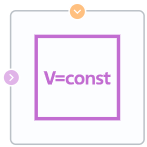
Block appearance in REPEAT VISION#
The Constant Volume Chamber (P) block simulates the accumulation of mass and energy in a chamber containing fixed volume of coolant.
The user can specify from 1 to 4 input ports through which the coolant flows.
The coolant volume can exchange heat with heating network, for example, heat exchange with the environment through the Thermal port of the unit.
The medium enters the chamber the pressure upstream the inlet exceeds pressure in the chamber and flows out when pressure drop is reversed.
It is assumed that the flow resistance between the inlet and the chamber internal part is negligible. Thus, pressure inside the chamber is equal to pressure at the inlet ports.
Similarly, thermal resistance between the thermal port and chamber internal part is negligible and temperature inside is equal to temperature in the thermal port.
Mass flow rate calculation
Law of conservation of mass (1):
where:
\(\frac{\delta M}{\delta p}\) - partial derivative of gas mass by pressure at constant temperature and volume;
\(\frac{\delta M}{\delta T}\) - partial derivative of gas mass by temperature at constant pressure and temperature;
\(\dot{m_1}\), \(\dot{m_2}\), \(\dot{m_3}\), \(\dot{m_4}\) - mass flow through input ports, [kg/s].
where:
p - medium pressure in the chamber, [Pa];
T - medium temperature in the chamber, [℃];
ρ - medium density in the chamber, [kg/m\(^3\)];
V - chamber volume, [m\(^3\)];
Energy balance
Law of conservation of energy (4) :
where:
\(\frac{\delta U}{\delta p}\) - partial derivative of the internal energy of a gas by pressure at constant temperature and volume;
\(\frac{\delta U}{\delta T}\) - partial derivative of the internal energy of a gas by temperature at constant pressure and temperature;
Q - heat flux through the heat port, [W];
\(\phi_1\), \(\phi_2\), \(\phi_3\), \(\phi_4\) - energy fluxes through input ports, [W].
where:
Z - compressibility factor;
R - specific gas constant;
h - enthalpy of the medium in the chamber;
\(c_p\) - isobaric mass heat capacity.
Momentum balance
p=p\(_1\)=p\(_2\)=p\(_3\)=p\(_4\)
where p\(_1\), p\(_2\), p\(_3\), p\(_4\) - pressure of input ports, [Pa].
1. Properties#
Property |
Default value |
Description |
Units of measurement |
|---|---|---|---|
Number of ports: |
1 |
- |
- |
Chamber volume |
2.0 |
- |
m\(^3\) |
Port 1 cross-sectional area |
0.01 |
- |
m\(^2\) |
Port 2 cross-sectional area, available when |
0.01 |
- |
m\(^2\) |
Port 3 cross-sectional area, available when |
0.01 |
- |
m\(^2\) |
Port 4 cross-sectional area, available when |
0.01 |
- |
m\(^2\) |
Initial temperature of liquid volume |
20.0 |
- |
°C |
Initial gauge pressure of liquid volume |
0.0 |
- |
Pa |
2. Inputs and outputs#
Parameters |
Input/Output |
Description |
Units of measurement |
Port type |
|---|---|---|---|---|
Input |
Input |
- |
- |
Pneumatics |
Input, available when |
Input |
- |
- |
Pneumatics |
Input, available when |
Input |
- |
- |
Pneumatics |
Input, available when |
Input |
- |
- |
Pneumatics |
Input |
- |
- |
Heat exchange |
In order to see the connection capabilities of the block, you need to go to page Description of block ports
3. Examples of use#
Examples of using this block can be found in the following sections:
Description of Demo.
Tutorials
Library |
Tutorial name |
|---|---|
|
How-to guides
Section |
Guide name |
|---|---|
Life support engineering |