

Vehicle body#
Block appearance in REPEAT VISION#
The Vehicle body block models the longitudinal dynamics of a two-axle vehicle (Veh). A vehicle may have the same or different numbers of wheels on each axle. To specify a different number of wheels on each axle, select the Different number of wheels per axle option in the ‘Wheel configuration’ parameter. It is assumed that all wheels on the vehicle are the same size.
The unit takes into account the body mass, aerodynamic drag, road slope and weight distribution between the axles caused by acceleration and road profile. Optionally, the dynamics of the longitudinal body tilt, caused by the suspension, can be taken into account. Veh does not move vertically relative to the ground.
The block can account for additional mass and moment of inertia using an external port. It is also possible to specify the aerodynamic drag coefficient using an external port.
The axes of a Veh are parallel and form a plane. The longitudinal direction (x-axis) lies in this plane and is perpendicular to the axes. If the vehicle moves along an inclined surface (with an inclination angle β), the normal direction (z-axis) is not parallel to gravity but is always perpendicular to the plane formed by the axes and the longitudinal direction.
In Fig. 1 the variables of the Veh movement model are defined:
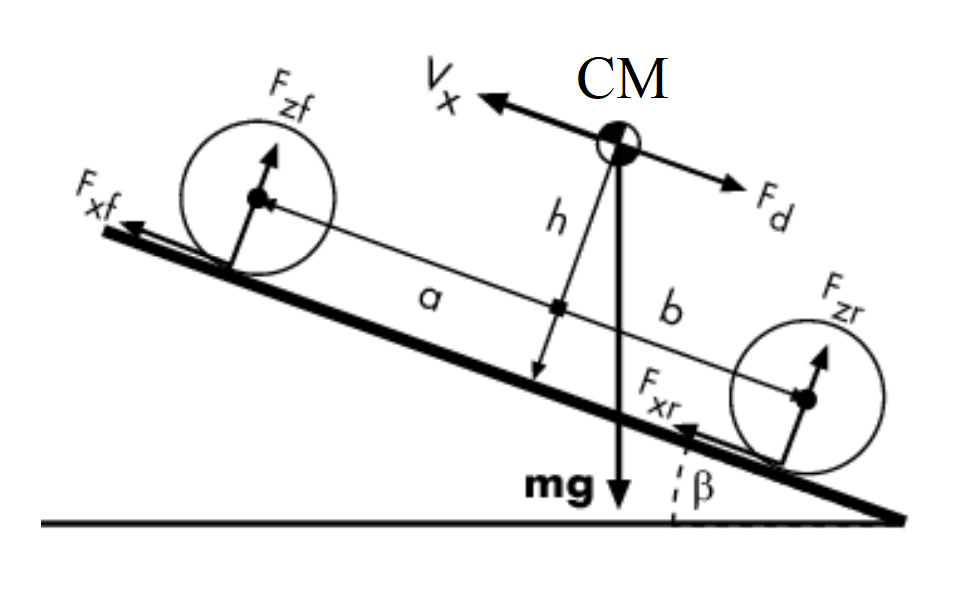
Fig. 1 Variables of the Veh movement model#
Variables determining the dynamics of the movement Veh:
g - acceleration of gravity, [m/s\(^2\)];
β - road slope angle, [rad];
m - mass of the Veh, also taking into account the additional mass specified by the external port when the Externally-defined additional mass parameter is enabled, [kg];
h - height of the CG Veh above the ground, [m];
a, b - distances from the front and rear axles, respectively, to the projection point CG along the normal to the common plane of the axes;
\(V_x\) - speed of the Veh;
Note
When \(V_x\) > 0, forward movement occurs; when \(V_x\) < 0, backward movement occurs
n - number of wheels on the axle;
\(F_{xf}, F_{xr}\) - longitudinal forces on each wheel at the points of contact of the front and rear wheels with the road surface, respectively;
\(F_{zf}, F_{zr}\) - normal load forces on each wheel at the points of contact of the front and rear wheels with the road surface, respectively;
\(V_w\) - wind speed;
Note
When \(V_w\) > 0, the wind is headwind;
When \(V_w\) < 0, the wind is tailwind.
A - frontal area, [m\(^2\)];
\(C_d\) - aerodynamic drag coefficient;
\(\rho\) - air density, [kg/m\(^3\)];
\(F_d\) - aerodynamic drag force, [N].
General description of the roles of forces in longitudinal dynamics:
The longitudinal forces of the wheels \(F_{xf}, F_{xr}\) push the vehicle forward or backward;
The force of gravity m \(\cdot\) g acts through CG Veh, and depending on the angle of inclination, pulls it either backward or forward;
Aerodynamic drag \(F_d\) slows down the Veh regardless of the direction of movement. The model assumes that the aerodynamic force is applied in the CG, therefore it participates in the formation of the longitudinal moment that affects the tilt of the body.
Important
If the normal reaction becomes negative, this means the wheel is lifting off the road. The unit doesn’t simulate lifting, so the result may be physically incorrect.
The expression that calculates the longitudinal dynamics of a Veh (1):
where the total longitudinal force \(F_x\) is specified through the mechanical port Body and corresponds to the force of interaction with the CG of the body and the wheels. Relative to the axle configuration, \(F_x\) is specified by the following expressions:
The same number of wheels on the axles (2) :
Different number of wheels on the axles (3) :
where:
\(n_f\) - number of wheels on the front axle;
\(n_r\) - number of wheels on the rear axle.
Aerodynamic drag force (4) :
where \(V_{thr}\) is the speed limit for calculating the aerodynamic drag force, [m/s].
The expressions for normal forces use the quantity (5) :
which is equivalent to the longitudinal force \(F_x\) transmitted through the CG.
Normal force on front wheels:
The same number of wheels on the axles (6) :
Different number of wheels on the axles (7) :
Normal force on rear wheels:
The same number of wheels on the axles (8) :
Different number of wheels on the axles (9) :
Normal forces on the wheels satisfy the condition:
The same number of wheels on the axles (10) :
Different number of wheels on axles (11) :
Hint
When the Externally-defined additional mass option is enabled, additional mass distance ports from the CG and an external mass port Additional mass appear. The block automatically recalculates the total mass, the position of the center of mass, and the total moment of inertia, taking into account the values of the external ports.
When an external mass \(m_{ext}\) is connected, its horizontal position changes the effective distances from the CG to the axles: the CG position is recalculated as a weighted average, which leads to a change in the arms a, b and h, which leads to a recalculation of the normal forces and suspension dynamics (12) :
where:
\(CG_x\) - longitudinal displacement CG of additional mass relative to CG Veh (specified by the external port);
\(CG_y\) - vertical displacement CG of the additional mass relative to CG Veh (set by the external port);
\(m_{total}\) - the total mass of the Veh taking into account the mass specified by the external port.
Note
When taking into account suspension dynamics (the Linear option in the Specify pitch model parameter), the block uses a small-angle approximation to calculate the longitudinal tilt of the vehicle body.
When the linear suspension model is included, dynamic components \(F_{suspf}\), \(F_{suspr}\) are added to the static distribution of normal forces, proportional to the angle of inclination and the rate of its change (13) :
where:
\(a_{total}\) - front axle shoulder (in the absence of external mass equal to \(a\)), [m];
\(b_{total}\) - rear axle shoulder (in the absence of external mass equals \(b\)), [m];
\(k_f\) - front axle suspension stiffness, [N/m];
\(d_f\) - front axle suspension damping, [N\(\cdot\)s/m];
\(k_r\) - rear axle suspension stiffness, [N/m];
\(d_f\) - rear axle suspension damping, [N\(\cdot\)s/m].
Suspension forces are applied to the body at the axle attachment points and affect the moment that causes pitching.
The angular acceleration \(\ddot \theta\) depends on three components of the moment and inertia Veh (14) :
where:
\(\ddot \theta\) - angular acceleration, [rad/s\(^2\)];
\(h_{total}\) - height of the CG, [m] (in the absence of external mass, equal to h);
\(J\) - total moment of inertia, [kg \(\cdot\) m\(^2\)] (also takes into account additional inertia with an external specified mass).
Note
A positive value of \(\theta\) corresponds to a backward tilt.
Hint
Also, when modeling the dynamics of longitudinal tilt, you can set the initial conditions: the angle of inclination of the body and the rate of its change.
1. Properties#
Property |
Default Value |
Description |
Units of measurement |
|---|---|---|---|
Mass |
1540.0 |
- |
kg |
Wheel configuration: |
Same number of wheels per axle |
- |
- |
Number of wheels per axle |
2 |
Available, when |
- |
Number of front wheels |
2 |
Available, when |
- |
Number of rear wheels |
2 |
Available, when |
- |
Horizontal distance from CG to front axle |
1.3 |
- |
m |
Horizontal distance from CG to rear axle |
1.4 |
- |
m |
CM height above ground |
0.4 |
- |
m |
Frontal area |
2.4 |
- |
m\(^2\) |
Drag coefficient |
0.27 |
- |
- |
Air density |
1.225 |
- |
kg/m\(^3\) |
Gravitational acceleration |
9.81 |
- |
m/s\(^2\) |
Off |
- |
- |
|
Off |
- |
- |
|
Off |
- |
- |
|
Initial velocity |
0.0 |
Available, when |
m/s |
Specify pitch model: |
None |
- |
- |
Pitch moment of inertia |
4000.0 |
Available, when |
kg \(\cdot\) m\(^2\) |
Front suspension damping |
10000.0 |
Available, when |
N/(m/s) |
Front suspension stiffness |
10000.0 |
Available, when |
N/m |
Rear suspension damping |
10000.0 |
Available, when |
N/(m/s) |
Rear suspension stiffness |
10000.0 |
Available, when |
N/m |
Initial pitch |
0.0 |
Available, when |
rad |
Initial pitch rate |
0.0 |
Available, when |
rad/s |
2. Inputs and outputs#
Parameters |
Input/Output |
Description |
Units of measurement |
Port type |
|---|---|---|---|---|
Input |
- |
- |
Translational motion |
|
Wind speed |
Input |
- |
m/s |
Automation |
Incline angle |
Input |
- |
rad |
Automation |
Drag coefficient |
Input |
Available, when |
- |
Automation |
Input |
Available, when |
kg |
Automation |
|
Longitudinal offset of additional mass CM |
Input |
Available, when |
m |
Automation |
Vertical offset of additional mass CG |
Input |
Available, when |
m |
Automation |
Front axle normal force |
Output |
- |
N |
Automation |
Rear axle normal force |
Output |
- |
N |
Automation |
Velocity |
Output |
- |
m/s |
Automation |
In order to see the connection capabilities of the block, you need to go to page Description of block ports