

Screw-nut gear (simplified)#
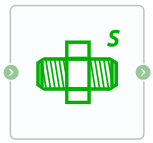
Block appearance in REPEAT VISION#
A simplified screw-nut model simulates a screw transmission, where rotary motion is converted into linear motion. It connects two axes of the power transmission - screw (S) and nut (N) - so that one rotates and the other moves linearly, with a fixed specified ratio.
The direction of the nut’s movement can be specified—positive (right-hand thread) or negative (left-hand thread). If the thread is right-hand, the screw’s angular velocity \(\omega_{s}\) and the nut’s linear velocity \(v_{n}\) have the same sign. If the thread is left-handed, the signs \(\omega_{s}\) and \(v_{n}\) are opposite.
The block connects the angular velocity of the screw with the translational velocity of the nut: each full revolution of the screw causes a linear movement of the nut by the step value L (1) :
where:
\(\omega_{s}\) – angular velocity of the propeller;
\(v_{n}\) – speed of the nut.
If we express the equation through the gear ratio \(R_{гв} = 2 \cdot \frac{\pi }{L}\), then (2) :
where \(L\) is the screw thread pitch (the movement of the nut per one turn of the screw).
Two degrees of freedom are reduced to one independent one. The transfer of moment and force is described as follows (3) :
where:
\(M_{s}\) – torque on the screw;
\(F_{n}\) – force on the nut;
\(F_{losses}\) – power losses during power transmission. \(𝐹_{losses}\) = 0 without taking into account losses.
1. Calculate losses#
When the Calculate losses \(F_{losses}
eq\) 0 property is enabled, losses are calculated relative to Efficiency.
Given Efficiency:
In the variant with constant values Efficiency \(\eta_{вг}\) and \(\eta_{гв}\) are specified by the user regardless of the thread geometry.
Calculation of Efficiency depending on the geometric characteristics of the gearing:
When contact engagement is taken into account, the coefficients \(η_{вг}\), \(\eta_{гв}\) are determined relative to:
Thread geometry - through the helix angle (λ) and half thread angle (α);
Coefficient of friction of surfaces k (4) :
Note
The full calculation of the coupling Efficiency occurs if the transmitted power exceeds the specified threshold value \(p_{прг}\). Otherwise, for numerical stability, the Efficiency is assumed to be equal to unity.
Restrictions:
• The inertia of the components is negligible;
• The components are considered absolutely rigid.
2. Properties#
Property |
Default Value |
Description |
Units of measurement |
|---|---|---|---|
Screw lead |
0.015 |
Nut displacement per revolution of the screw |
m |
On - right-hand type thread; |
Off |
Direction of movement of the nut during positive rotation of the screw: |
- |
Off |
- |
- |
|
Efficiency screw - nut, available when selecting |
0.45 |
- |
- |
Efficiency nut - screw, available when selecting |
0.75 |
- |
- |
Power threshold, available when selecting |
0.001 |
- |
W |
Calculate losses by friction coefficient and geometrical parameters, available when selecting |
Off |
- |
- |
Acme thread half angle, available when selecting |
14.5 |
- |
degrees |
Lead angle, available when selecting |
20 |
- |
degrees |
Friction coefficient, available when selecting |
0.08 |
- |
degrees |
3. Inputs and outputs#
Parameters |
Input/Output |
Description |
Units of measurement |
Port type |
|---|---|---|---|---|
Screw |
Input |
- |
- |
Rotational motion |
Nut |
Output |
- |
- |
Translational motion |
In order to see the connection capabilities of the block, you need to go to page Description of block ports