
Needle Valve (P)#
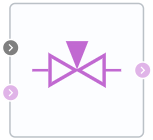
Block appearance in REPEAT VISION#
The block describes the flow of gas through a needle valve, in which the needle closes the hole for the flow of gas when seated in the seat.
The amount of valve opening (needle raising) displacement is given by the sum of the external signal S and needle displacement (needleOffset) in the closed position of the valve.
When the valve is closed (displacement <0), the flow area is equal to the leak area.
When displacement > Seat diameter (displacement of the needle exceeds the diameter of the valve seat), the flow area is unchanged and maximum.
The block can use the smoothing option with the Smoothing factor>0 parameter value for the displacement parameter at the extreme positions (comparable to 0 or Seat Diameter, where Seat diameter is the valve seat diameter).
Also, the pressure recovery option can be used in the block - to enable it, set the Pressure recovery parameter to On.
The opening area of the valve is calculated as (1):
where:
\(h\) is the vertical distance between the outer edge of the needle and the saddle, as shown in the diagram above;
\(θ\) is the cone angle of the saddle, which always corresponds to the needle cone angle;
\(d_0\) — diameter of the seat hole;
\(A_{leak}\) - leak zone.
The area of the hole is limited by the maximum displacement \(h_{max}\) (2):
For any needle displacement greater than \(h_{max}\) , \(A\) is the sum of the maximum opening area and leak area (3):
For any combination of signal at port S and needle displacement less than 0, the minimum valve area is the leak area.
Mass flow rate calculation
The blockt calculates the mass flow rate as (4):
where:
\(C_d\) – discharge coefficient;
\(S_r\) – opening area, [m\(^2\)];
S — cross-sectional area of ports A and B, [m\(^2\)];
\( ho\) – gas density, [kg/m\(^3\)];
p - gas pressure, [Pa];
\(\gamma\) - adiabatic exponent.
Linearization of the equation when \(\frac{p_{out}}{p_{in}}\)>B\(_{lam}\) (5):
When the pressure ratio is less than the ratio \(\frac{p_{out}}{p_{in}}\) < \((\frac{2}{\gamma +1})^\frac {\gamma}{\gamma-1}\), the equation takes (6):
Law of conservation of energy (7):
where:
\(\phi_А\) - energy flow at the input, [W];
\(\phi_В\) - energy flow at the output, [W].
1. Properties#
Property |
Default Value |
Description |
Units of measurement |
|---|---|---|---|
Off |
- |
- |
|
Seat diameter |
0.1 |
- |
m |
Cone angle |
90 |
- |
degrees |
Needle offset |
0.0 |
- |
m |
Leakage area |
1.0e-10 |
- |
m\(^2\) |
Port area |
0.07 |
- |
m\(^2\) |
Discharge coefficient, available when |
0.64 |
- |
- |
0.01 |
- |
- |
|
Laminar flow pressure ratio |
0.999 |
- |
- |
2. Inputs and outputs#
Parameters |
Input/Output |
Description |
Units of measurement |
Port type |
|---|---|---|---|---|
Needle offset |
Input |
- |
m |
Automation |
Input |
Input |
- |
- |
Pneumatics |
Output |
Output |
- |
- |
Pneumatics |
In order to see the connection capabilities of the block, you need to go to page Description of block ports