

Simplified lateral movement#
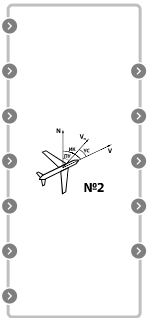
Block appearance in REPEAT VISION#
When dividing complex movement of missiles into longitudinal and lateral, it is assumed that in the first approximation the longitudinal movement does not depend on lateral one. Thus, only those forces and moments that operate in the firing plane are taken into account in the equations for determining the characteristics of longitudinal movement. When determining the characteristics of the lateral movement of a missile, it cannot be considered independent of the longitudinal one, therefore, all forces and moments, which in some degree can cause the missile to deviate from the firing plane, are included in the equations.
System of equations describing lateral motion of rocket center of mass in half-speed coordinate system 0XYZ (1), (2), (3), (4), (5) and (6):
Equations describing only lateral motion cannot be solved independently, without considering the basic values determined by longitudinal motion. For example, in a system, the first equation is basic in determining lateral motion parameters, but it is solved only if m(t), v(t) and 0(t) are known. Aerodynamic forces and laterally acting moments cannot also be determined unless speed and altitude are known.
At large trajectory rotation angles, it is necessary to check the limits of applicability of the formula determining Yc.
A significant simplification of the system can be obtained if an artificial technique is applied and the pitch and roll angles of the trajectory are assumed to be equal to 0 in the equations defining the angular parameters of the rocket motion. This assumption is equivalent to the idea that the rocket flies in a horizontal position, its longitudinal axis makes an angle p with the velocity vector of the center of mass, and the angle \(\gamma_c\)=0.
&Emsp;To obtain results close to the actual results, in the equations defining the conditional horizontal trajectory of the missile’s center of mass, its velocity should be taken equal to \( u \cdot cos heta\), the multipliers of which are determined by solving the system of equations describing the longitudinal motion of the missile’s (projectile’s) center of mass. With the assumptions made, a simpler system of differential equations (7), (8), (9), (10) and (11) follows from the system of differential equations above:
The penultimate equation can be replaced by the sum of angles (12):
1. Properties#
Property |
Default Value |
Description |
Units of measurement |
|---|---|---|---|
Initial value of the trajectory rotation angle |
-13/57.3 |
- |
rad |
Yaw angle initial value |
0 |
- |
rad |
Initial value of angular velocity of AD rotation |
0 |
- |
rad/s |
Initial values for lateral displacement |
0 |
- |
m |
2. Inputs and outputs#
Parameters |
Input/Output |
Description |
Units of measurement |
Port type |
|---|---|---|---|---|
\(v\) |
Input |
AD speed module |
m/s |
Automation |
Theta (\(\theta\)) |
Input |
Flight-path angle |
rad |
Automation |
P\(_y\) |
Input |
AD engine thrust in projection on the half-speed axis 0Z* |
N |
Automation |
Z |
Input |
Aerodynamic force on axis 0Z* |
N |
Automation |
MR\(_{y}\) |
Input |
Projection of the moment in a related coordinate system on axis Y |
N\(\cdot\)m |
Automation |
J\(_y\) |
Input |
AD inertia moments |
kg\(\cdot m^2\) |
Automation |
m |
Input |
AD mass |
kg |
Automation |
PSI \(\Psi\) |
Output |
Trajectory rotation angle |
rad |
Automation |
W\(_{y1}\) |
Output |
Angular speed of AD rotation relative to connected axes |
rad/s |
Automation |
psi \(\psi\) |
Output |
Yaw angle |
rad |
Automation |
betta \(\beta\) |
Output |
Gliding angle |
rad |
Automation |
Z\(_{z}\) |
Output |
Lateral offset |
m |
Automation |
In order to see the connection capabilities of the block, you need to go to page Description of block ports