

Direct current motor#
Block appearance in REPEAT VISION#
The Direct current motor block is a direct current motor (DC motor), which has the possibility to select a separate circuit or permanent magnets as exciter, specifying their flux linkage.
The equation of DC motor motion is based on the formula (1):
where the electromagnetic torque \(М_{ЭМ}\) is calculated according to (2)
where
c - design constant of the motor;
\(Ф_{ОВ}\) - magnetic flux of excitation winding, [Wb], which is calculated by the following formula (3):
where
\(L_{ОВ}\), \(N_{ОВ}\) - excitation winding inductance, [H], and its amount.
\(I_{ОВ}\), \(I_{якорь}\) - currents in the excitation winding and armature, [A].
The equation of DCM motion is based on the formula (4):
where
p - number of magnetic pole pairs;
N - number of active conductors in the armature winding;
a - number of pairs of parallel branches in the armature winding.
The back-EMF in this block is determined by the formula (5):
where
c - design constant of the motor;
Ф\(_{ОВ}\) - field winding magnetic flux, [Wb];
\(\omega\) - angular velocity, [rad/s].
Important
In many sources of literature, the constants of the motor c\(_m\), “c\(_e\) are used to calculate the electromagnetic torque and counter-EMF. However the formula c\(_м\)=\(\frac{p\cdot N}{2 \cdot П \cdot a}\) differs from c\(_е\)=\(\frac{p\cdot N}{60 \cdot a}\) only in additional multiplier \(\frac{2\cdot П}{60}\) for calculation of counter-EMF relative to the number of revolutions per minute (rpm) E=c\(_е\) \(\cdot\) Ф\(_{ОВ}\) \(\cdot\) n. And to calculate the counter-EMF relative to the angular velocity (rad/s), a structural coefficient is used, calculated by the formula \(\frac{p\cdot N}{2\cdot П \cdot a}\). Therefore, in this block, the structural coefficient is general, since the counter-EMF is considered relative to the angular velocity.
It is also possible to implement a motor with permanent magnets instead of an excitation circuit, the magnetic flux value is entered by the user.
When the armature and excitation windings are connected in series, the motor operates in series excitation mode. A distinctive feature of this excitation type is the nonlinear characteristic of the motor magnetic flux from the current Fig. 1:
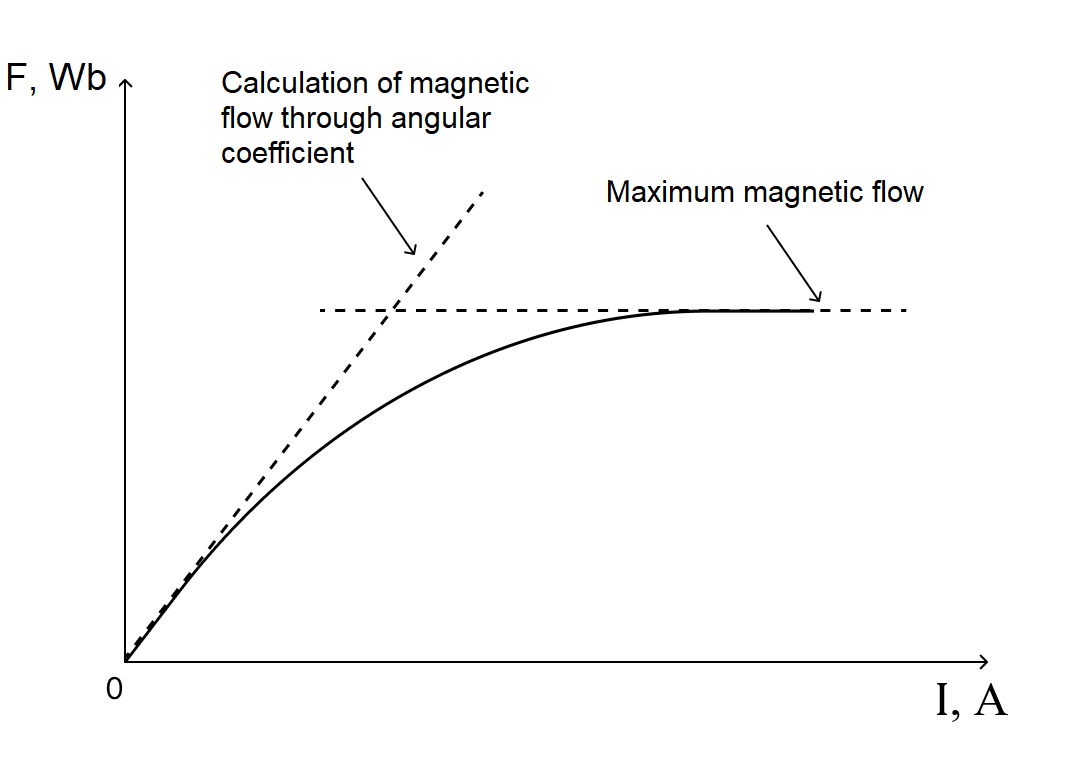
Fig. 1 Magnetic flux curve#
As there is no clear analytical expression for this curve, in this block it is possible to calculate the magnetic flow through the angular coefficient α. It is necessary to switch on the toggle switch Series wound DC motor. It is also possible to set the maximum magnetic flow crooked.
1. Properties#
Property |
Default value |
Description |
Units of measurement |
|---|---|---|---|
Armature resistance |
1.1 |
– |
Ohm |
Armature inductance |
1e-3 |
– |
H |
Motor constant |
0.34 |
– |
– |
Field resistance |
1e-3 |
– |
Ohm |
Field inductance |
1e-3 |
– |
H |
Number of windings |
10 |
– |
– |
Inertia |
0.005 |
Rotor inertia |
kg\(\cdot\) m\(^2\) |
Friction coefficient |
100e-3 |
– |
N\(\cdot\) m\(\cdot\) s |
Off |
Permanent magnet excitation |
– |
|
Off |
Field circuit and armature in series connection |
– |
|
Magnets’ flux linkage |
0.1 |
Available, when |
Wb |
Saturation curve coefficient, available, when |
0.01 |
Saturation curve slope coefficient |
Wb/A |
Flux saturation value, available, when |
0.1 |
Maximum flux value |
Wb |
2. Inputs and outputs#
Parameters |
Input/Output |
Description |
Units of measurement |
Port type |
|---|---|---|---|---|
+ Обмотка возбуждения |
Input |
– |
– |
Electronics |
+ Якорь |
Input |
– |
– |
Electronics |
Applied torque |
Input |
External moment of shaft drag force |
N\(\cdot\) m |
Automation |
- Обмотка возбуждения |
Output |
– |
– |
Electronics |
- Якорь |
Output |
– |
– |
Electronics |
Angular velocity |
Output |
– |
rad/s |
Rotational motion |
In order to see the connection capabilities of the block, you need to go to page Description of block ports