

Four-axle vehicle#
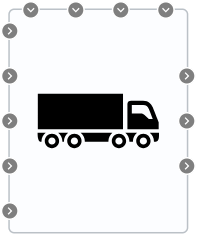
Block appearance in REPEAT VISION#
The Four-axle vehicle block describes the movement of avehicle with a trailer, taking into account the road profile and the influence of wind.
Forces acting on the vehicle:
traction force (1) :
where:
\(M_{1}\) - engine torque, [N\(\cdot\)m];
\(M_{2},M_{3},M_{4}\) – torque of auxiliary engines, [N\(\cdot\)m];
\(r\) – carriage wheel radius, [m];
\(GR\) – transmission gear ratio, gearless.
rolling force (2) :
where:
\(m_{v}\) - vehicle weight, [kg];
\(g\) – gravity factor, [m/s\(^2\)];
\(\alpha\) – road elevation angle, [rad].
rolling friction force (3) :
where:
\(k_{fr}\) – rolling friction coefficient, gearless;
\(k_{lf}\) – lifting force coefficient, [kg/m];
\(\alpha\) – road elevation angle, [rad];
\(V_{\mathrm{s}\mathrm{u}\mathrm{m}\mathrm{m}}=V_{v}+V_{w}\) – sumof vehicle and headwind velocities, [m/s].
adhesion force (4) :
where:
\(k_{visc}\) – vehicle viscous drag coefficient, [kg/s];
\(F_{fr} \) – rolling friction force, [N];
\(V_v\) – vehicle speed, [m/s].
aerodynamic drag force (5) :
where:
\(k_{drag} \) – vehicle drag coefficient, [kg/m];
\(V_{sum}=V_a+V_в \) – sum of vehicle and headwind velocities, [m/s].
braking force (6) :
where \( М_{brake} \) – brake torque, [N\(\cdot\) m].
Vehicle acceleration calculation (7) :
where:
\(F_{prop}\) – propulsive force, [N];
\(F_{aero}\) – vehicle aerodynamic drag force, [N];
\(F_{roll}\) – vehicle rolling force, [N];
\(F_{tract}\) – traction force of wheels on the road surface, [N];
\(F_{tr}\) – drag force of the trailer, [N];
\(F_{brake}\) – braking force, [N];
\(m_v\) – vehicle weight, [kg];
\(m_{tr}\) – trailer mass, [kg];
\(J\) – nertia moment of all axes, [kg\(\cdot\) m\(^2\)];
\(r\) – carriage wheel radius, [m].
1. Properties#
Property |
Default value |
Description |
Units of measurement |
|---|---|---|---|
Radius of wheel |
0.6 |
– |
m |
Inertia moment of axes |
200 |
– |
kg \(\cdot\) m\(^2\) |
Vehicle mass |
15000 |
– |
kg |
Trailer mass |
0 |
– |
kg |
Viscosity resistance coefficient |
0 |
– |
kg/s |
Lifting force coefficient |
0 |
– |
kg/m |
Head resistance coefficient |
0 |
– |
kg/m |
Rolling friction coefficient |
0 |
– |
m |
Free fall acceleration |
9.81 |
– |
m/s\(^2\) |
2. Inputs and outputs#
Parameters |
Input/Output |
Description |
Units of measurement |
Port type |
|---|---|---|---|---|
Car motor torque |
Input |
– |
N \(\cdot\) m |
Automation |
Additional motor torque 1 |
Input |
– |
N \(\cdot\) m |
Automation |
Additional motor torque 2 |
Input |
– |
N \(\cdot\) m |
Automation |
Additional motor torque 3 |
Input |
– |
N \(\cdot\) m |
Automation |
Climb angle |
Input |
– |
rad |
Automation |
Headwind speed |
Input |
– |
m/s |
Automation |
Trailer motion resistance force |
Input |
Port for connecting an auxiliary motor. The calculationassumes that the load is distributed symmetrically between all axes. |
N \(\cdot\) m |
Automation |
Braking torque |
Input |
Port for connecting an auxiliary motor. The calculationassumes that the load is distributed symmetrically between all axes. |
N \(\cdot\) m |
Automation |
Gear ratio |
Input |
Port for connecting an auxiliary motor. The calculationassumes that the load is distributed symmetrically between all axes. |
gearless |
Automation |
Displacement |
Output |
– |
m |
Automation |
Car speed |
Output |
– |
m/s |
Automation |
Car acceleration |
Output |
– |
m/s\(^2\) |
Automation |
In order to see the connection capabilities of the block, you need to go to page Description of block ports