

Internal combustion engine#
Block appearance in REPEAT VISION#
The Internal combustion engine (ICE) block is a generalized model of an internal combustion engine, the moment is calculated relative to the values of power and angular velocity in r.u. by a third-order polynomial.
A normalized throttle signal is supplied to the engine input, taking a value from 0 to 1. A moment is created at the output port, see Fig. 1:
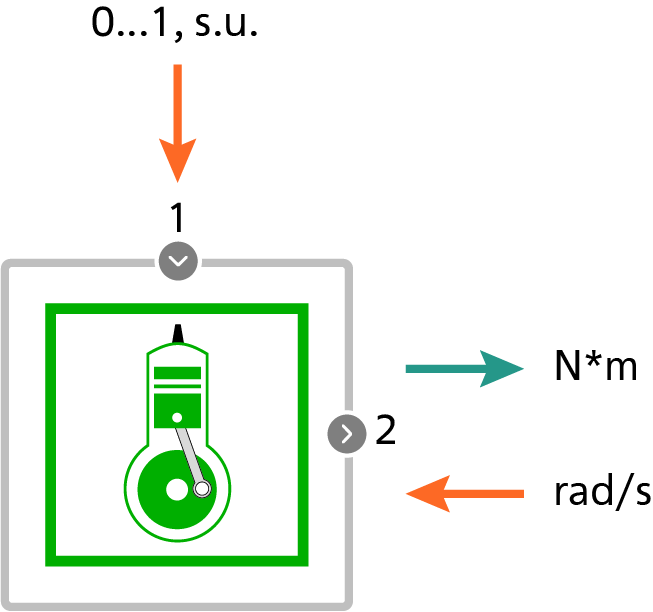
Torque calculation for ICE with forced ignition and compression ignition
Since the calculations are carried out in r.u., the relative angular velocity is first calculated (1):
where:
\(\omega_{ICE}\) - ICE angular velocity, [rad/s];
\(\omega_{max.pow.}\) - ICE angular speed at maximum power (rotation speed at maximum power, values are converted to [rad/s] inside the block).
Power in relative units is calculated by the formula (2):
Then Тогда \(P_{s.u.}(1)\) = 1 и \(dP(1)/d\omega\) = 0.
In named units, the power is (3):
We know that ICE torque formula is (4):
Then, taking into account the relative units and the throttle signal, the torque formula will take the form (5):
where control is a throttle input signal (port 1 signal in Fig. 1 above).
Characterization factor |
Engine type: ICE with forced ignition |
Engine type: ICE with compression ignition |
|---|---|---|
\(s_1\) |
1 |
0.6526 |
\(s_2\) |
1 |
1.6948 |
\(s_3\) |
-1 |
-1.3474 |
Calculation of torque for ICE with calculation of factors
This type of engine is suitable for your calculations when, instead of speed at maximum power, you know the maximum engine torque \(T_{max.}\) and its speed at maximum torque \(\omega_{max.moment}\)
In this type, the speed at maximum power is calculated using a formula (6):
Coefficients are calculated according to formulas (7), (8), (9):
The moment is calculated using a formula (10):
Idling
The engine incorporates the idle control system to automatically control the throttle in order to maintain preset angular frequency. The control signal is generated in accordance with the derivative (11):
where:
\(\omega_{idling setpoint}\) - setpoint for idle speed;
\(\omega_{idling threshold}\) – lower threshold of idle rotation frequency;
\(\tau_{idling}\) – time constant of idle speed controller;
It should be noted that if there is an input control signal, the signal with the highest value is chosen (12):
Limitations in the model
It is worth noting a couple of important limitations when modeling with this block:
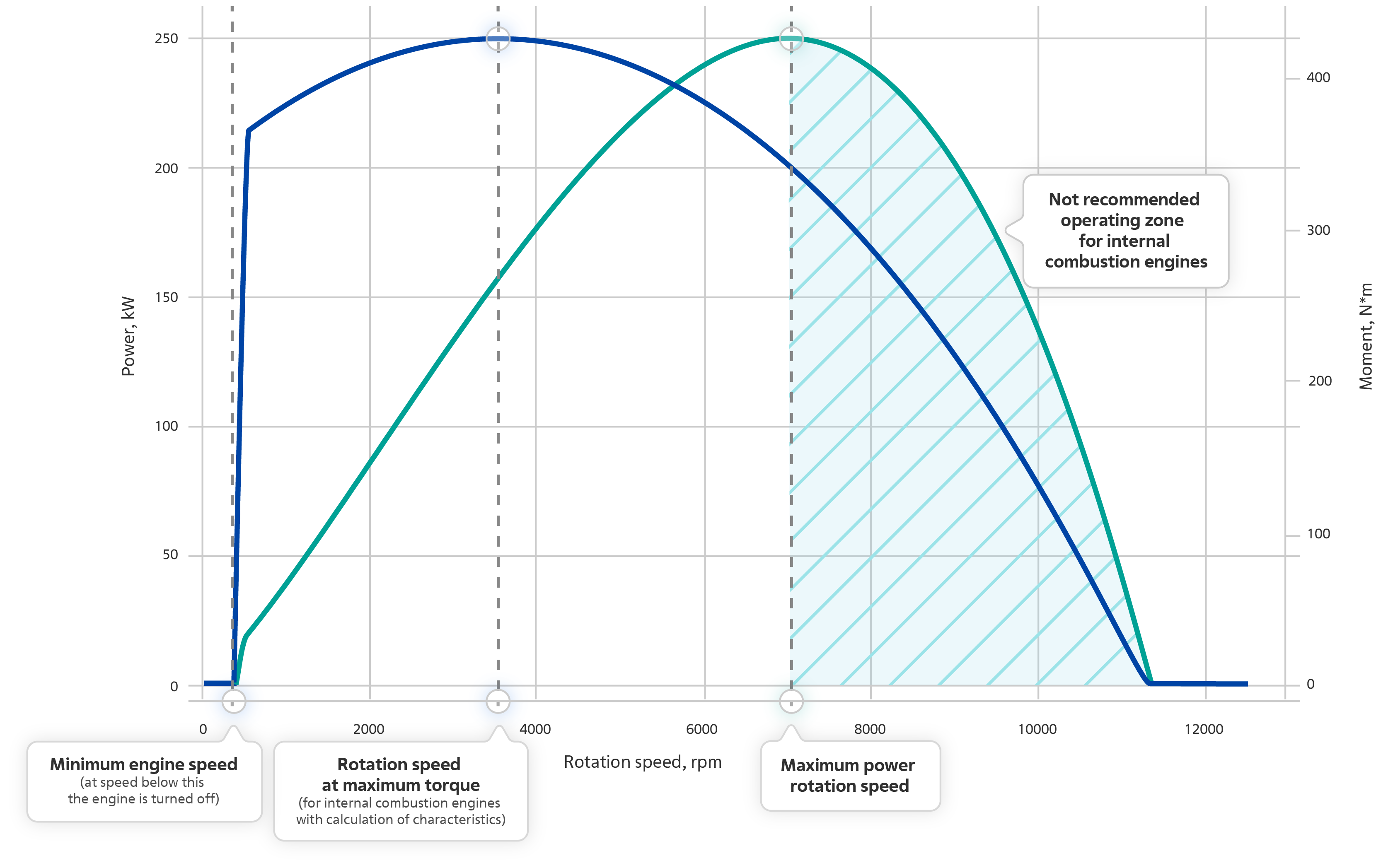
The block limits the engine rotational frequency to a range above the minimum speed \(0< \omega_{min.} < \omega_{ICE}. \). However, this does not mean that the operation of ICE above the maximum power speed is permissible. After reaching the maximum power, the function \(P_{r.u.}(\omega_{r.u.}) \) will decrease and the torque may become negative. When the negative torque is reached, ICE automatically stalls: the torque and control signal become zero;
Engine power at minimum frequency \(P_{ICE} (ω_{min.} )\) shall be positive;
Engine power at maximum speed \(P_{ICE} (ω_{max.pow.} )\) shall be positive.
Important points in ICE modeling
When the angular frequency decreases below \(\omega_{min.}\), ICE gets tuned off, see Fig. 2 below, (the generated torque and control signal are 0);
ICE, as in real life, will not start by itself, to start the engine it is necessary to apply an angular speed higher than \(\omega_{min.} \), for example, at the moment of inertia connected to the engine, indicate the initial speed.
1. Properties#
Property |
Default Value |
Description |
Units of measurement |
|---|---|---|---|
Speed at maximum power |
6858.0 |
- |
rpm |
Maximum power |
230.0 |
- |
kW |
Stall speed |
200.0 |
- |
rpm |
Engine time constant |
0.1 |
- |
s |
Idle speed control reference |
1000.0 |
- |
rpm |
Idle speed control threshold |
300.0 |
- |
rpm |
Idle speed control controller time constant |
0.1 |
- |
s |
Fuel consumption coefficient |
0.001 |
- |
l/s/W |
Engine type: |
Spark-ignition |
- |
- |
Maximum torque, available when selecting |
360.0 |
- |
N\(\cdot\)m |
Speed at maximum torque, available when selecting |
4300.0 |
- |
rpm |
Stall speed threshold |
10 |
- |
rpm |
2. Inputs and outputs#
Parameters |
Input/Output |
Description |
Units of measurement |
Port type |
|---|---|---|---|---|
Command signal |
Input |
- |
- |
Automation |
Torque |
Output |
- |
N\(\cdot\)m |
Rotational motion |
In order to see the connection capabilities of the block, you need to go to page Description of block ports