

Screw - nut gear#
Block appearance in REPEAT VISION#
The Screw - nut gear block models a system in which rotational motion is converted to translational motion. The left port transmits the angular speed in [rad/s] and the right port transmits the linear velocity in [m/s].
The input port receives the angular velocity signal in [rad/s], the output port receives the velocity, [m/s] (see Fig. 1 below). Output port transmits force, [N].
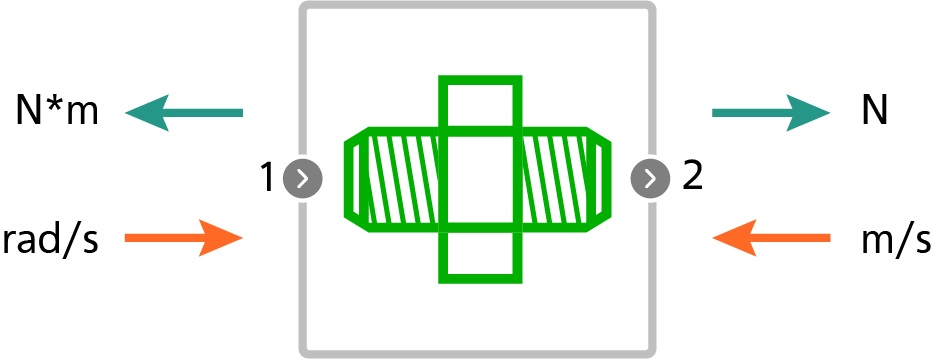
Fig. 1 Screw-nut gear block icon#
The stiffness and damping of the contact surface are necessary to calculate the normal force acting on the threads. Static friction and sliding friction factors shall be specified to account for friction.
In this unit, the “Integrator with reset” friction model is implemented, in which the magnitude of the static friction force depends on the boundary distance of static friction, which is specified in the unit properties.
The resultant force consists of normal and tangent components. Normal force depends on relative speed and distance traveled (1) :
where:
k - hardness, [N/m];
d - damping, [N \(\cdot\) s/m];
v\(_{rel}\) - relative linear velocity of bodies, [m/s] (2) :
where:
\(\alpha\) - lifting angle, [rad];
R - screw radius, [m].
Hint
If one wants to simulate co-directional rotation of mechanical objects, one shall supply a negative speed value to the output port of the unit.
Important
A negative value for the lead angle models the right screw thread.
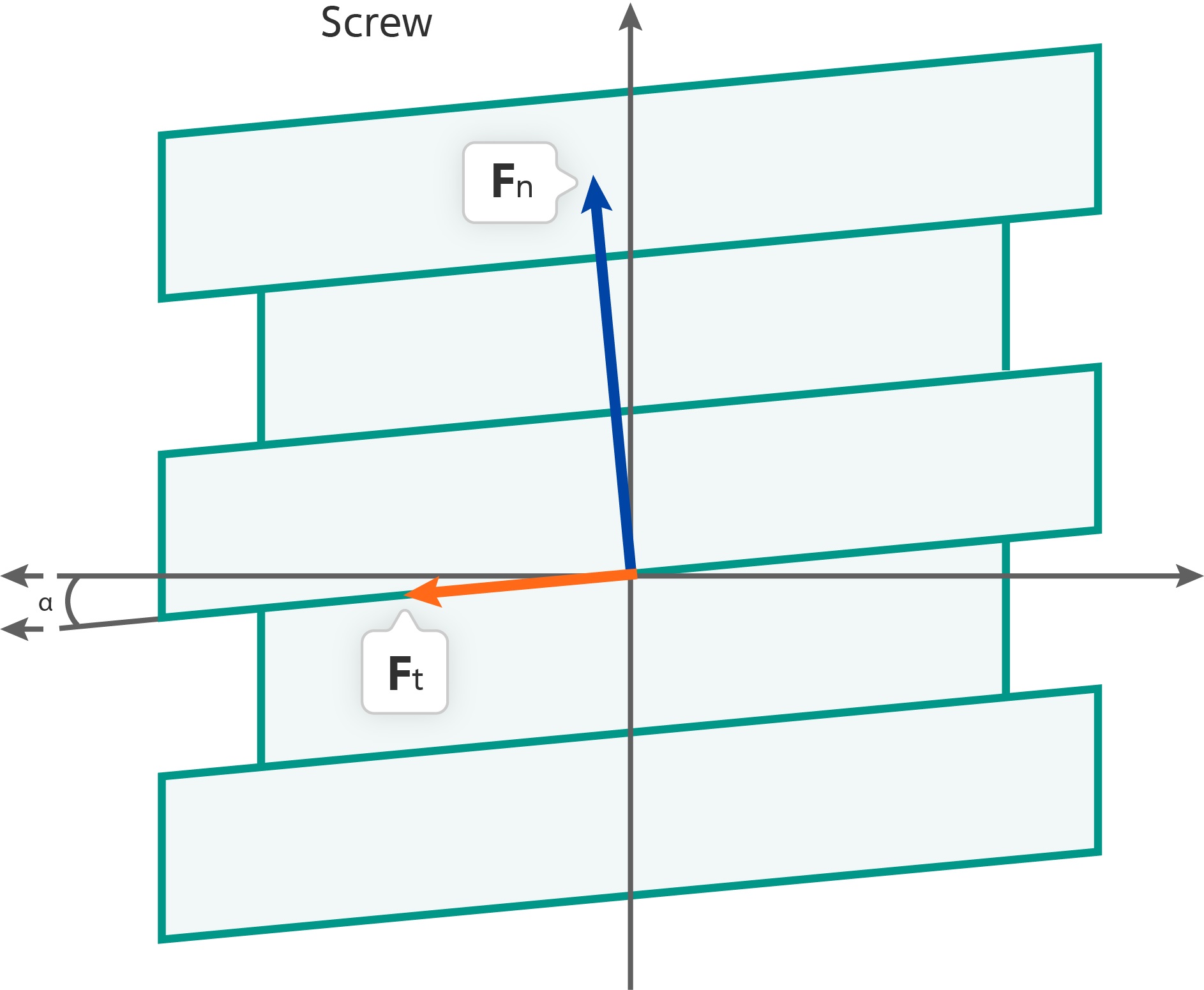
Fig. 2 Forces on the thread surface#
Initially, the transmission is in rest mode, a static friction force is formed at a non-zero relative speed (3) :
In static friction, the tangential force depends on the distance boundary s\(_{boundary}\) (4) :
where:
\(k_{static.}\) - stiffness at static friction, [r.u.];
\(s_{boundary}\) - boundary distance, at overcoming of which sliding mode occurs, [m];
\(c_{static.}\) - coefficient of static friction, [r.u.];
\(v_{rel.tang.}\) - relative speed parallel to screw thread turn surface, [m/s].
In sliding mode, friction is calculated relative to the normal force using the expression (5) :
The Stribeck effect allows a smooth transition between static and dynamic friction. Turn on the Account Stribeck effect toggle switch to take this effect into account. With this configuration, the friction force becomes exponential and is determined by the expression (6) :
The force acting on the nut F\(_{but}\) and the moment acting on the screw М\(_{screw}\) are calculated using the formulas (3) :
Hint
Also, translational motion is converted to rotational using the toggle switch Reverse motion dircetion.
1. Properties#
Property |
Default value |
Description |
Units of measurement |
|---|---|---|---|
Mean diameter |
0.01 |
- |
m |
Lead angle |
2.0 |
- |
deg |
Contact stiffness |
1000.0 |
- |
N/m |
Contact damping |
1000.0 |
- |
N/(m/s) |
Coulumb friciton coefficient |
0.01 |
- |
r.u. |
Stiction coefficient |
0.02 |
- |
- |
Stiction stiffnes |
1000.0 |
- |
N/(m/s) |
Stiction displacement threshold |
0.001 |
- |
- |
Off |
- |
- |
|
Stribeck effect transfer velocity, available when select |
0.001 |
- |
m/s |
Off |
On - conversion of rotational motion into translational motion; |
- |
2. Inputs and outputs#
Parameters |
Input/Output |
Description |
Units of measurement |
Port type |
|---|---|---|---|---|
Angular velocity |
Input |
Available when |
rad/s |
Rotational motion |
Speed |
Input |
Available when |
m/s |
Translational motion |
Force |
Output |
Available when |
N |
Translational motion |
Torque |
Output |
Available when |
N\(\cdot\) m |
Rotational motion |
In order to see the connection capabilities of the block, you need to go to page Description of block ports