

Clarke-Park transform (αβ0-dq0)#
Block appearance in REPEAT VISION#
The Clarke-Park transform (αβ0-dq0) block performs a direct or reverse transformation of coordinates αβ0-dq0 In the block, it is possible to select the type of location of axis d relative to the axis of phase A, the type of location of axis \(\beta\) relative to the axis of phase A.
Direct Clarke-Park Transform makes it possible to switch from αβ0 fixed two-phase system connected to the electronic motor stator with zero component to dq0 two-phase system rotating with rotor speed.
Note
This component will be 0 for a symmetric system.
The reverse Clarke-Park Transform allows making the reverse transition: from the dq0 coordinate system to the αβ0 coordinate system.
Note
The transformation type is determined by the selected value of property Transform direction.
The formulas for direct (1) and reverse (2) transformations in general form are given below:
where:
\(\alpha\),\( \beta\),0 – components of the two-phase coordinate system \(\alpha \beta\)0;
d, q, 0 – components of dq0 two-phase coordinate system;
\(\omega t \) – angle that determines the position of dq0 coordinate system at time moment t when moving at an angular speed \(\omega\);
\(\Theta _{dq}\) – angle between axes A and d;
\(\Theta _{\beta}\) – angle between axis \( \beta\) and the vertical axis.
The value \(\omega \)t is an input parameter for the block and is user-defined.
The value \(\Theta _{dq}\) is set in the block in the property
d axis position at the initial time. Depending on the selected value, axis d at the initial moment of time can be aligned with axis of phase A (see Fig. 1, a below), lag behind it by 90⁰ (see Fig. 1, b below) or can be shifted by an arbitrary angle relative to the axis of phase A (see Fig. 1, c below) in the range from -180⁰ to 180⁰ .
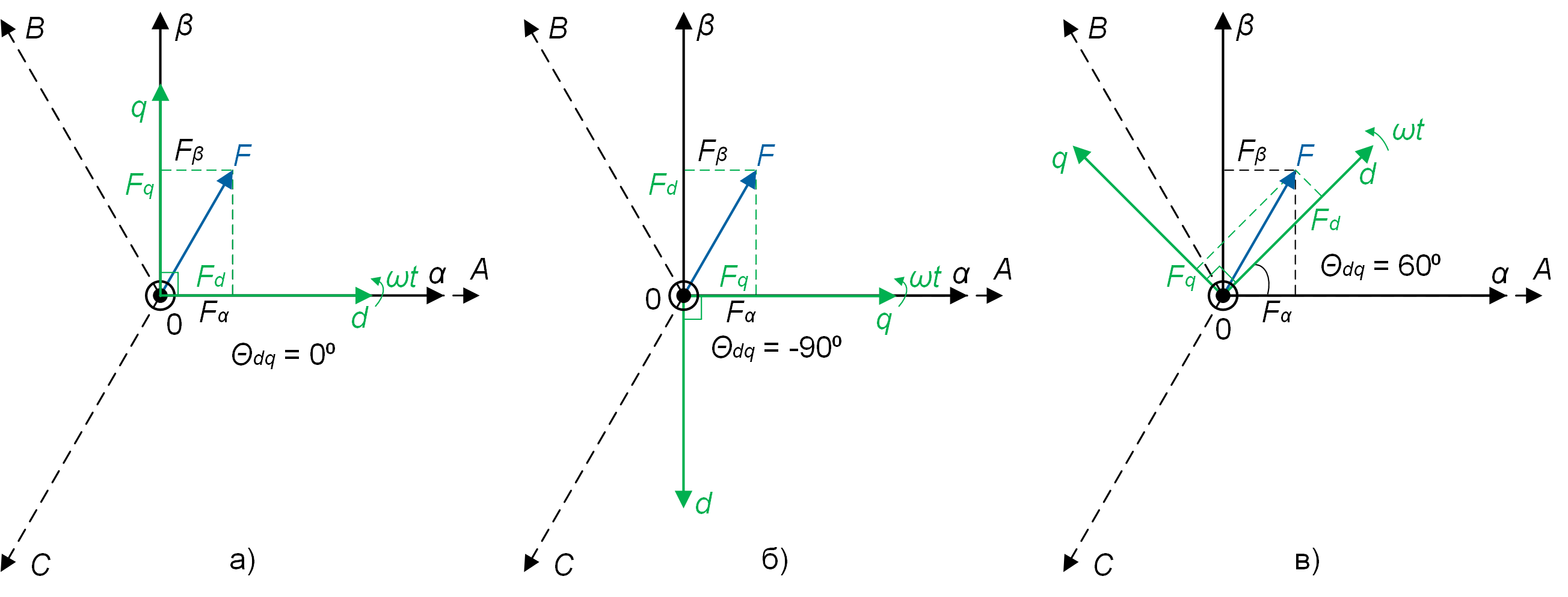
Fig. 1 Location of axes of coordinate systems at different values of the angle \(\Theta _{dq}\) at the initial moment of time#
The value \(\Theta _{\beta}\) is set in the block in the property
β axis position. Depending on the selected value, axis \(\beta\) can be ahead of phase A by 90⁰ (see Fig. 2, a below) or 90⁰ behind it (see Fig. 2, b below).
Note
In the first case, the angle \(\Theta _{\beta}\) = 0, in the second \(\Theta _{\beta}\) = 180⁰.
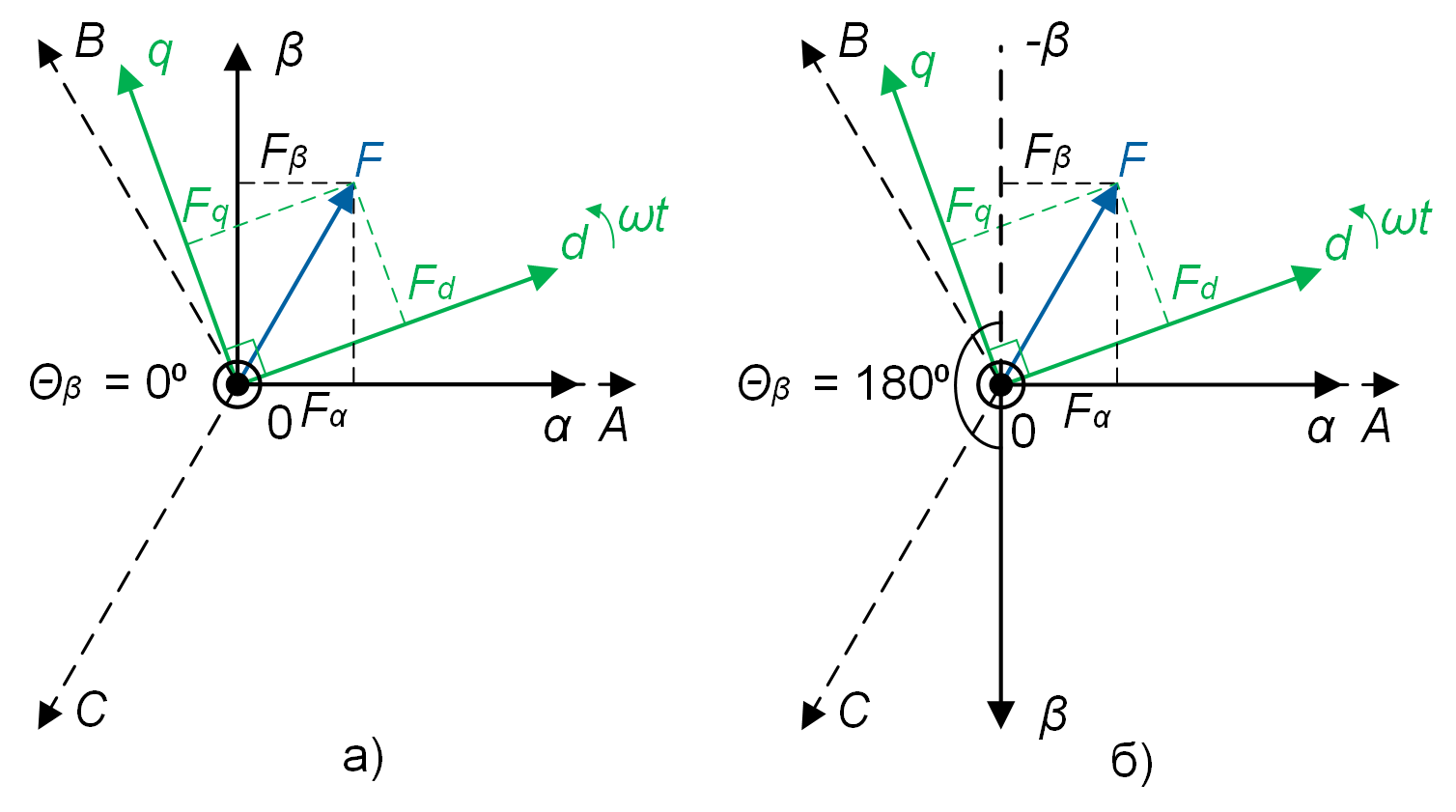
Fig. 2 Location of coordinate system axes at different values of angle \(\Theta _{\beta}\)#
Fig. 1 and 2 show vector F – a generalized or depicting vector of a three-phase system rotating at a speed of \(\omega\)t.
1. Properties#
Property |
Default Value |
Description |
Units of measurement |
|---|---|---|---|
Direct |
- |
- |
|
90° before A axis |
- |
- |
|
Aligned with A axis |
- |
- |
|
45 |
- |
deg |
Note
Property becomes available when selecting the Other value in the property d axis position at the initial time
2. Inputs and outputs#
Note
The name of some input and output parameters depends on the value of the property Transform direction
Parameters |
Input/Output |
Description |
Units of measurement |
Port type |
|---|---|---|---|---|
\(\alpha\) (“Direct”) / |
Input |
- |
- |
Automation |
\(\beta\) (“Direct”) / |
Input |
- |
- |
Automation |
0 |
Input |
- |
- |
Automation |
\(\omega\) t |
Input |
- |
rad |
Automation |
d (“Direct”) / |
Output |
- |
- |
Automation |
q (“Direct”) / |
Output |
- |
- |
Automation |
0 |
Output |
- |
- |
Automation |
In order to see the connection capabilities of the block, you need to go to page Description of block ports
3. Code generation#
Important
Block supports C source code generation