
Poppet Valve (P)#
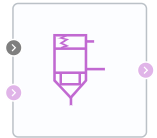
Block appearance in REPEAT VISION#
The Poppet Valve (P) block simulates changes in the energy and pressure of gas when passing the respective component of the pneumatic system.
The valve gets opened or closed according to the Normolize offset signal transmitted to the port. This port takes the distance between the cylinder and the seat.
The valve flow area is determined by the expression (1):
where:
h — distance between cylinder and seat, [m];
\( heta\) - seat cone inclination angle, [deg];
d\(_s\) - cylindrical valve diameter, [m];
A\(_{leak}\) - leakage area, [m\(^2\)].
The valve flow area is limited by the maximum shift h\(_{max}\) (2):
For any stem shift greater than h\(_{max}\), A\(_{open}\) is the sum of the maximum valve flow area and the leakage area {eq} ‘PoppetValveP3’:
When the valve is fully closed, the flow area is equal to the leakage area.
Mass flow rate calculation
The block calculates the mass flow rate as (4):
where:
\(C_d\) – discharge factor;
\(S_r\) – hole area, [m\(^2\)];
S - cross-sectional area of ports A and B, [m\(^2\)];
\( ho\) – gas density, [kg/m\(^3\)];
p - gas pressure, [Pa];
\(\gamma\) - adiabatic exponent.
Linearizing the equation at \(\frac{p_{out}}{p_{in}}\)>B\(_{lam}\) (5):
When the pressure ratio is less than \(\frac{p_{out}}{p_{in}}\) < \((\frac{2}{\gamma +1})^\frac {\gamma}{\gamma-1}\), the equation is {eq} ‘PoppetValveP6’:
Law of conservation of energy (7):
where:
\(\phi_А\) - input energy flow, [W];
\(\phi_В\) - output energy flow, [W].
1. Properties#
Property |
Default value |
Description |
Units of measurement |
|---|---|---|---|
Seat and poppet geometry: |
Conical seat, ball poppet |
- |
- |
Ball poppet diameter |
0.01 |
- |
m |
Seat orifice diameter, available when |
7e-3 |
- |
m |
Cylindrical stem diameter, available when |
0.01 |
- |
m |
Seat conical angle, available when |
120.0 |
- |
deg |
Leakage area |
1.0e-10 |
- |
m\(^2\) |
Port area |
0.1 |
- |
m\(^2\) |
Discharged coefficient |
0.64 |
- |
- |
Laminar flow pressure ratio |
0.999 |
- |
- |
2. Inputs and outputs#
Parameters |
Input/Output |
Description |
Units of measurement |
Port type |
|---|---|---|---|---|
Input |
- |
m |
Automation |
|
Input |
Input |
- |
- |
Pneumatics |
Output |
Output |
- |
- |
Pneumatics |
In order to see the connection capabilities of the block, you need to go to page Description of block ports